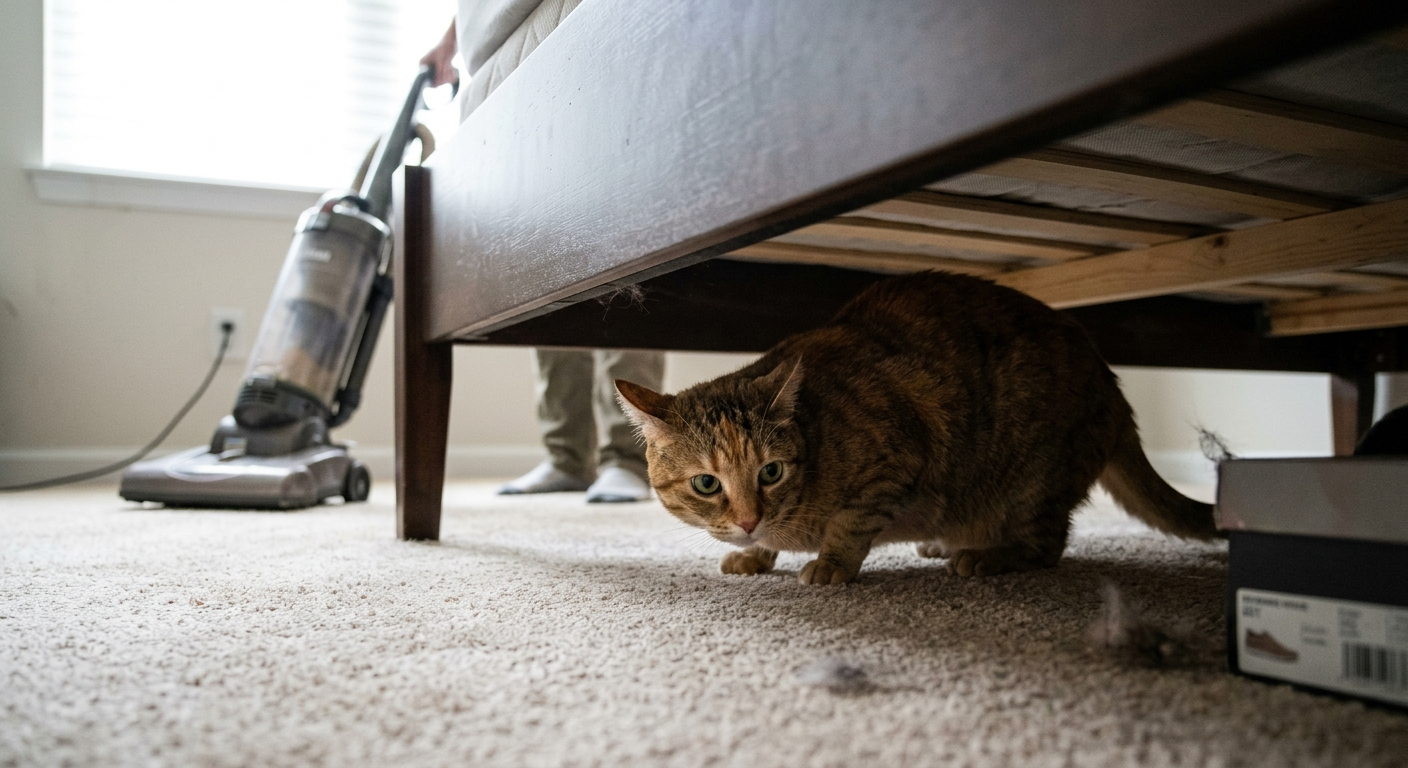
Cat hiding under bed is one of the most common worries cat owners have — and most of the time, it isn’t a problem at all. Under the bed is dark, enclosed, and low to the ground. To a cat, that’s not a sad place to sulk; it’s a den. It’s where they go to feel safe.
The question that actually matters isn’t whether your cat hides. It’s which kind of hiding you’re seeing, and whether anything else has changed.
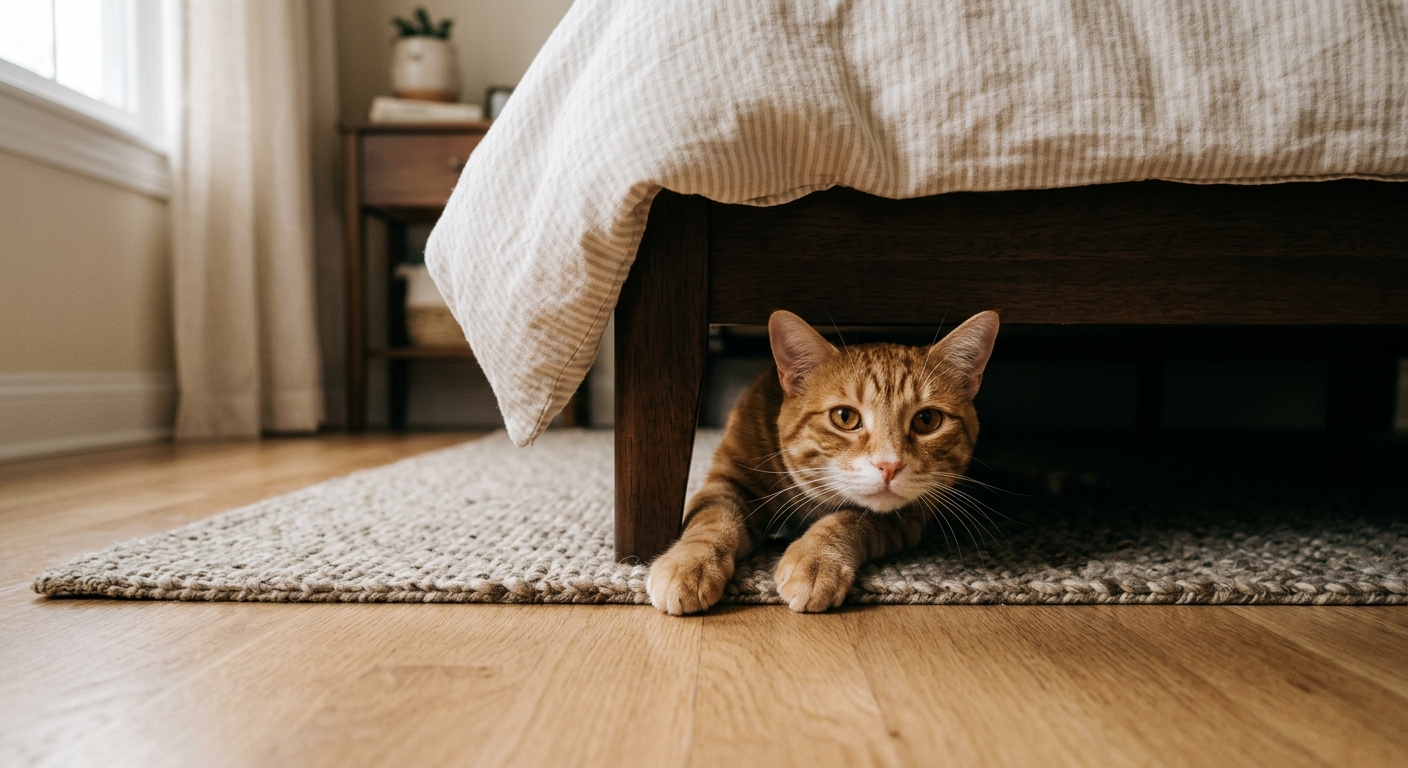
Cat hiding under bed is normal behaviour, especially for new or newly adopted cats, cats in a changed environment, and cats recovering from a vet visit. It becomes concerning when it’s a sudden change in a cat who never hid before, when it lasts more than a day or two with no obvious trigger, or when it comes with not eating, lethargy, or vomiting. Hiding alone is usually fine. Hiding plus a second symptom is a vet call.
- Not eating or drinking for more than 24 hours
- Vomiting, or having diarrhoea
- Breathing fast, panting, or breathing with visible effort
- Unable or unwilling to move when gently encouraged
- Showing pale gums, or crying out when touched
- A kitten or a senior cat — both have less reserve and deteriorate faster
Cats instinctively hide illness, so a cat that has taken itself somewhere dark and won’t come out for food is a genuinely different situation from a cat who’s simply found a favourite spot.
Why Cats Hide Under the Bed
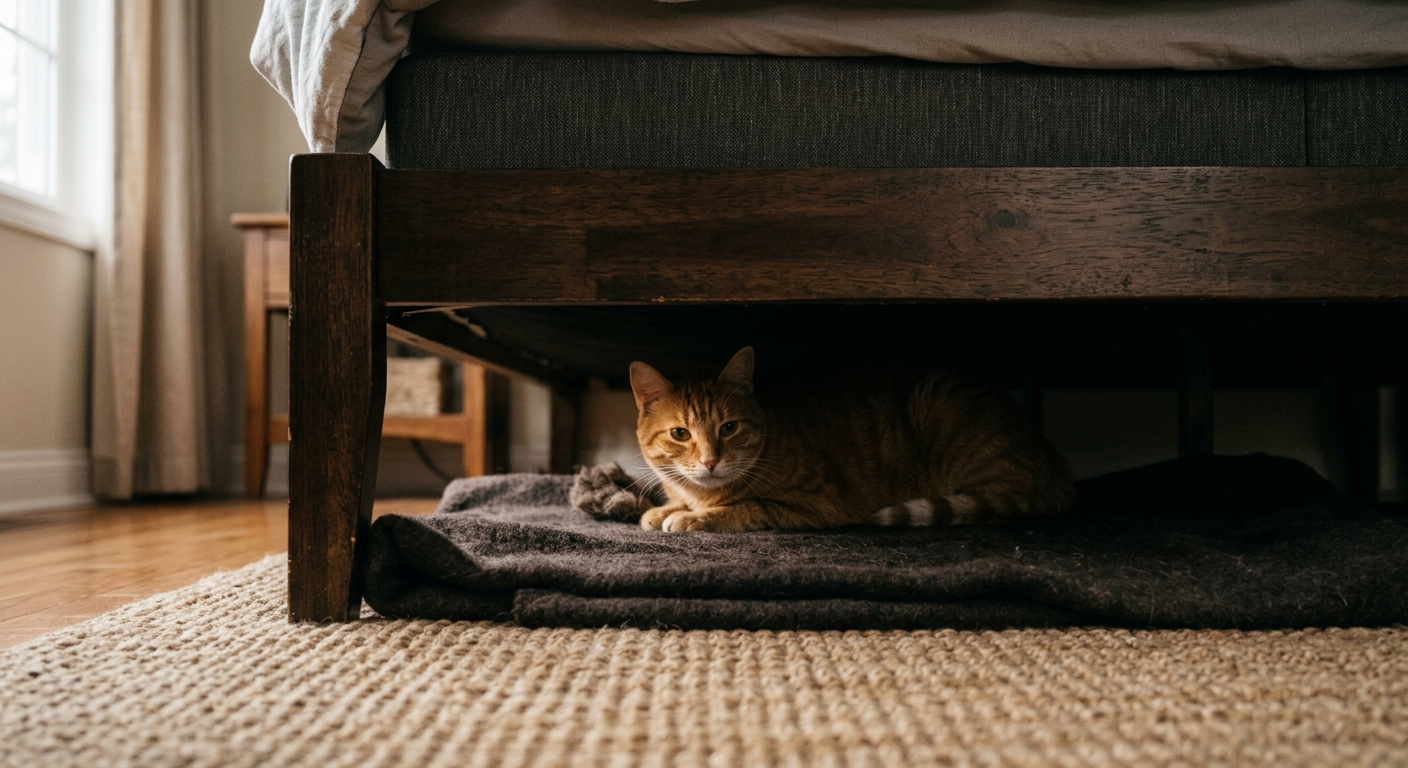 Cats are both predator and prey. That second half is the part owners forget — and it’s the part that explains the bed. A low, dark, enclosed space with one approach and a solid roof is exactly what a small animal looks for when it wants to feel unexposed.
So hiding under the bed isn’t unhappiness by default. It usually means one of these:
- Security — the space feels safe and defensible, especially in an unfamiliar or noisy home
- Decompression — a new cat processing an overwhelming amount of new smells, sounds, and people
- Avoiding stress — visitors, building work, a new pet, a change in routine
- Personality — some cats are simply more private than others and always have been. A naturally reserved cat who hides but eats, plays, and greets you on their own terms isn’t a problem to solve.
- Conflict with another pet — in multi-cat homes, one cat guarding food, litter, or a favourite spot can push another into hiding
- Rest — some cats simply prefer to sleep somewhere dark and undisturbed
- Illness or pain — the one that matters, and the reason a sudden change in hiding behaviour is worth attention
Hiding in a Multi-Cat Home
If you have more than one cat, hiding can be social rather than medical. A cat who is being blocked from the litter box, crowded at the food bowl, or repeatedly stared down by another cat will often withdraw somewhere defensible rather than fight over it — and because cat conflict is frequently silent, owners miss it.
The fix is resources, not discipline: one litter box per cat plus one spare, separate feeding stations in different rooms, and plenty of vertical space so cats can pass each other without confrontation. If one cat is consistently the one hiding, watch who approaches whom when they think you’re not looking.
Hiding in an Older Cat
A senior cat who starts hiding more deserves a closer look than a young one. Age-related pain — arthritis especially — makes a quiet, enclosed space more appealing, and it’s easy to mistake for “slowing down.” Cognitive decline can also play a part: older cats sometimes become confused or anxious and retreat to somewhere that feels manageable.
Neither should be written off as normal ageing without a vet check, because arthritis in particular is both common and genuinely treatable in cats.
Normal Hiding vs Concerning Hiding
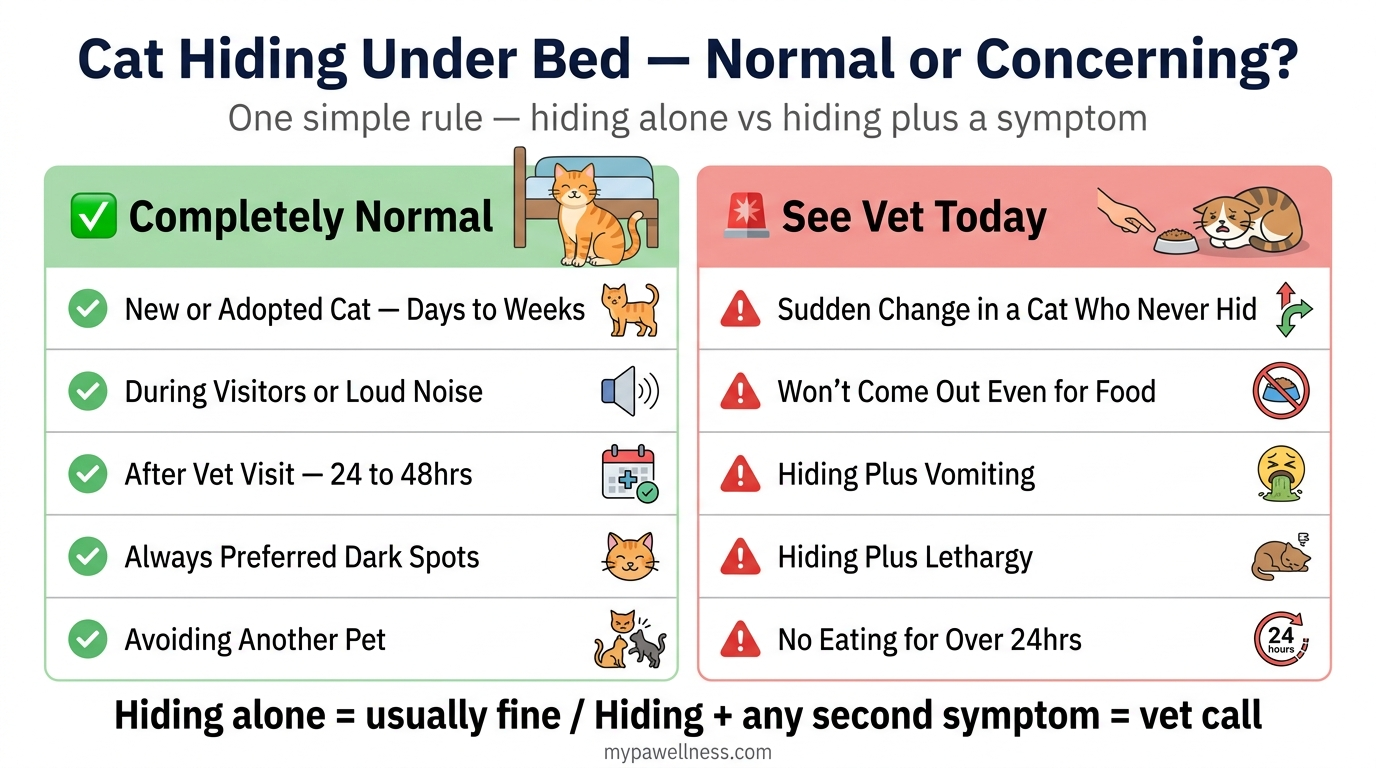 This is the distinction that answers most people’s real question:
| What You’re Seeing | What It Suggests | Action |
|---|---|---|
| A new or recently adopted cat hiding for days | Normal decompression | Give time and space; expect days, not hours |
| Hiding during visitors, noise, or building work | Normal stress avoidance | Leave them be; they’ll emerge |
| A cat who has always liked under the bed | Preference, not a problem | No action needed |
| Hiding for 24–48 hours after a vet visit | Normal recovery and stress | Monitor eating and drinking |
| Sudden hiding in a cat who never hid before | Possible illness, pain, or a new stressor | Look for other changes; vet if unclear |
| Hiding with not eating, vomiting, or lethargy | Likely illness | 🚨 Vet — don’t wait it out |
| Hiding and won’t come out even for food | Significant stress or illness | 🚨 Vet |
A New or Newly Adopted Cat Hiding Under the Bed
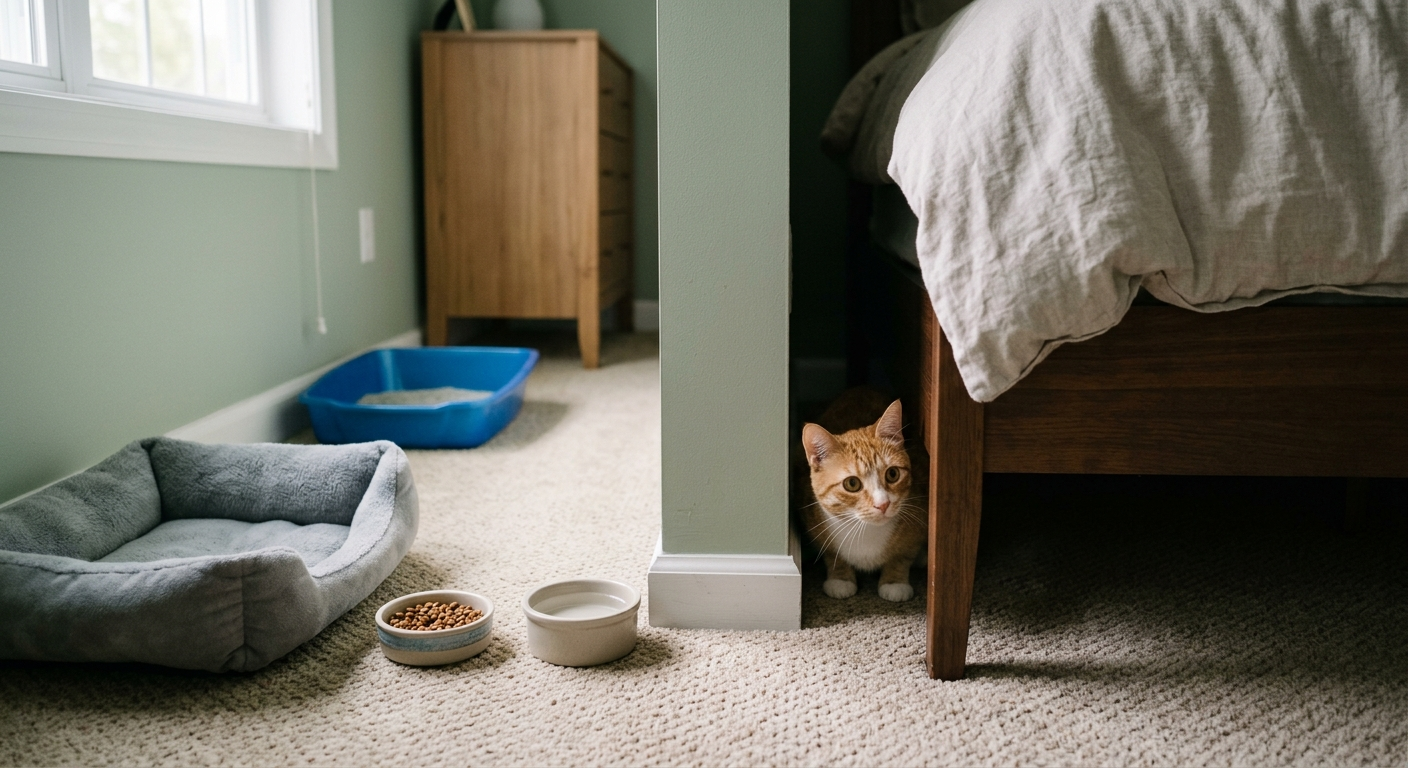 This is the most common version of the worry, and the most reassuring answer: it’s completely normal, and it usually takes longer than new owners expect.
A newly adopted cat has just lost everything familiar — their smells, their territory, their routine — and landed somewhere entirely new. Hiding is how they process that safely. Many cats spend the first few days almost entirely under a bed or behind furniture, coming out only at night to eat and use the litter box when the house is quiet.
A widely used rule of thumb for newly adopted cats is the 3-3-3 guideline: roughly three days to decompress, three weeks to settle into the routine, and three months to feel genuinely at home. It’s approximate, not a schedule — some cats emerge in hours, some shy ones take weeks — but it sets a realistic expectation.
What helps:
- Start them in one small room, not the whole house. A bathroom or spare room with food, water, litter, and a hiding spot is far less overwhelming.
- Put food, water, and litter within sight of the hiding place so they don’t have to cross open ground to reach them.
- Don’t pull them out. Dragging a frightened cat from a safe space teaches them you’re a threat and makes the next few days worse.
- Sit nearby and ignore them. Read, work, talk quietly. Letting them observe you without pressure is what builds trust fastest.
- Check they’re eating and using the litter box, even if it’s happening overnight. That’s the signal that matters.
The thing to watch, even in a new cat, is eating. A new cat who hides but eats overnight is doing fine. A new cat who hasn’t eaten in 24 hours needs a vet call, because cats can develop liver problems from not eating faster than most owners realise. Related: My Cat Won’t Eat.
Cat Hiding Under the Bed All of a Sudden
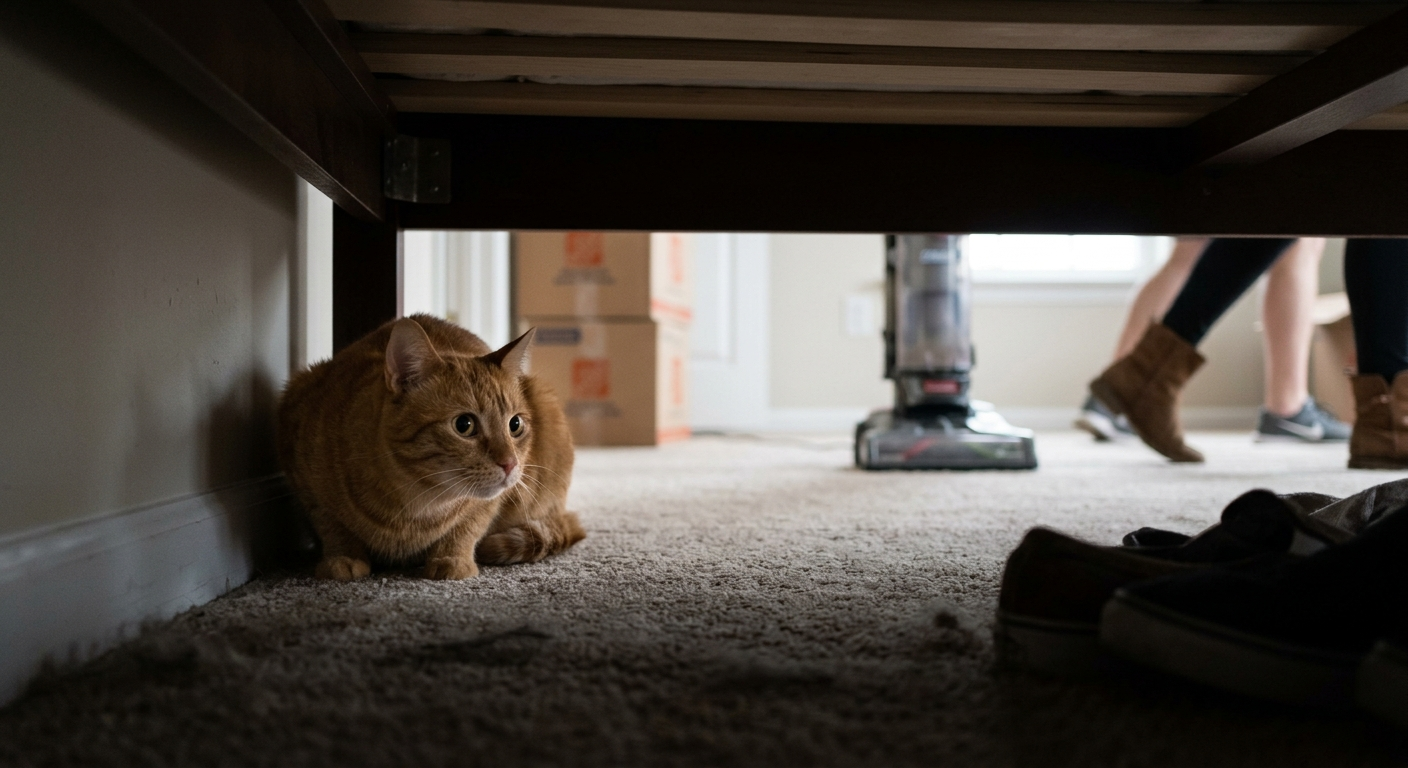 A cat who never hid before and now does is the version worth paying attention to. Something has changed — and your job is to work out whether it’s environmental or physical.
Environmental causes are the more common and the easier to fix:
- New people in the house, or a house guest staying
- A new pet, or a neighbourhood cat appearing at the windows
- Building work, a new appliance, or loud noise
- Furniture moved, a house move, or a new baby
- A change in your routine or schedule
- A frightening one-off event — a dropped pan, fireworks, a vacuum
These usually resolve within a few days once the trigger passes or the cat adjusts. If you can identify the trigger and the hiding is easing, that’s reassuring.
Physical causes are the reason sudden hiding shouldn’t be ignored. If nothing in the environment changed, or the hiding persists beyond a couple of days, illness or pain moves up the list — which is the next section.
Hiding After the Vet, Surgery, or Flea Treatment
Hiding for 24 to 48 hours after a vet visit is normal and expected. Your cat has been handled by strangers, been somewhere that smells alarming, and come home carrying unfamiliar scents. Retreating under the bed to reset is exactly what you’d predict.
The same applies after spay or neuter surgery, dental work, or a flea treatment application — grogginess from anaesthetic, mild discomfort, or an odd sensation on the skin all push a cat toward a quiet dark place.
What’s not normal after a procedure:
- Still hiding and not eating more than 24 hours later
- Any sign of pain — crying, flinching, guarding part of the body
- A surgical site that looks red, swollen, wet, or open
- Vomiting, or difficulty walking, beyond the first few hours after anaesthetic
Any of those means calling the clinic that did the procedure — they’ll want to know, and post-operative problems are much easier to fix early.
When Hiding Means Illness
Cats hide when they’re unwell because of an instinct that predates domestication: in the wild, an animal that visibly shows weakness becomes a target. Even a cat who has never seen a predator still carries the wiring that says when you feel bad, become invisible.
That instinct is exactly why hiding is such a useful signal for owners. Cats are famously good at masking pain and illness — they don’t limp dramatically or whine the way a dog might. Often, withdrawing is the first visible sign, appearing before any physical symptom you could point to.
Illness-related hiding tends to look like this:
- It’s a change from their normal behaviour, not a lifelong preference
- The cat stays hidden even when the house is quiet and calm
- They don’t come out for food, treats, or the things that normally tempt them
- There’s no environmental trigger you can identify
- Other small things are off too — appetite, grooming, litter box habits, energy
Conditions that commonly present this way include pain from dental disease or arthritis, urinary problems, kidney disease, and infections — all of which are far more treatable when caught early. Related: My Cat Is Lethargic But Eating and Drinking and Signs of Kidney Failure in Cats.
Hiding and Not Eating
This combination is the one to act on. Hiding alone is often fine. Hiding plus not eating is the pattern that most reliably means something is wrong.
It’s also time-sensitive in a way many owners don’t realise: cats who stop eating can develop hepatic lipidosis — a serious liver condition — within a couple of days, and overweight cats are at higher risk. That’s why “not eating” has a much shorter monitoring window than “hiding.”
The practical rule: if your cat has not eaten anything in 24 hours, call your vet, regardless of how they’re otherwise behaving. For kittens, seniors, or cats with existing health conditions, make that call sooner. Full detail: My Cat Is Not Eating or Drinking and Very Weak.
Hiding alongside vomiting is the same category — see Why Is My Cat Throwing Up for how to judge that.
How Long Is Too Long?
It depends entirely on which situation you’re in, which is why there’s no single number:
| Situation | Normal Duration | Too Long When |
|---|---|---|
| Newly adopted cat | Days to a few weeks | Not eating at all in 24 hrs, or no progress after several weeks |
| After a house move | Several days to a couple of weeks | Still fully hidden and not eating after a few days |
| After a vet visit or surgery | 24–48 hours | Beyond 48 hrs, or with pain signs at any point |
| Visitors or a loud event | Hours to a day | Continues well after the trigger is gone |
| Sudden hiding, no known trigger | Not really “normal” | More than a day or two, or with any other symptom |
Across all of them, the same override applies: any hiding accompanied by not eating, vomiting, laboured breathing, or obvious pain is a vet call now, not a wait-and-see.
How to Coax a Cat Out From Under the Bed
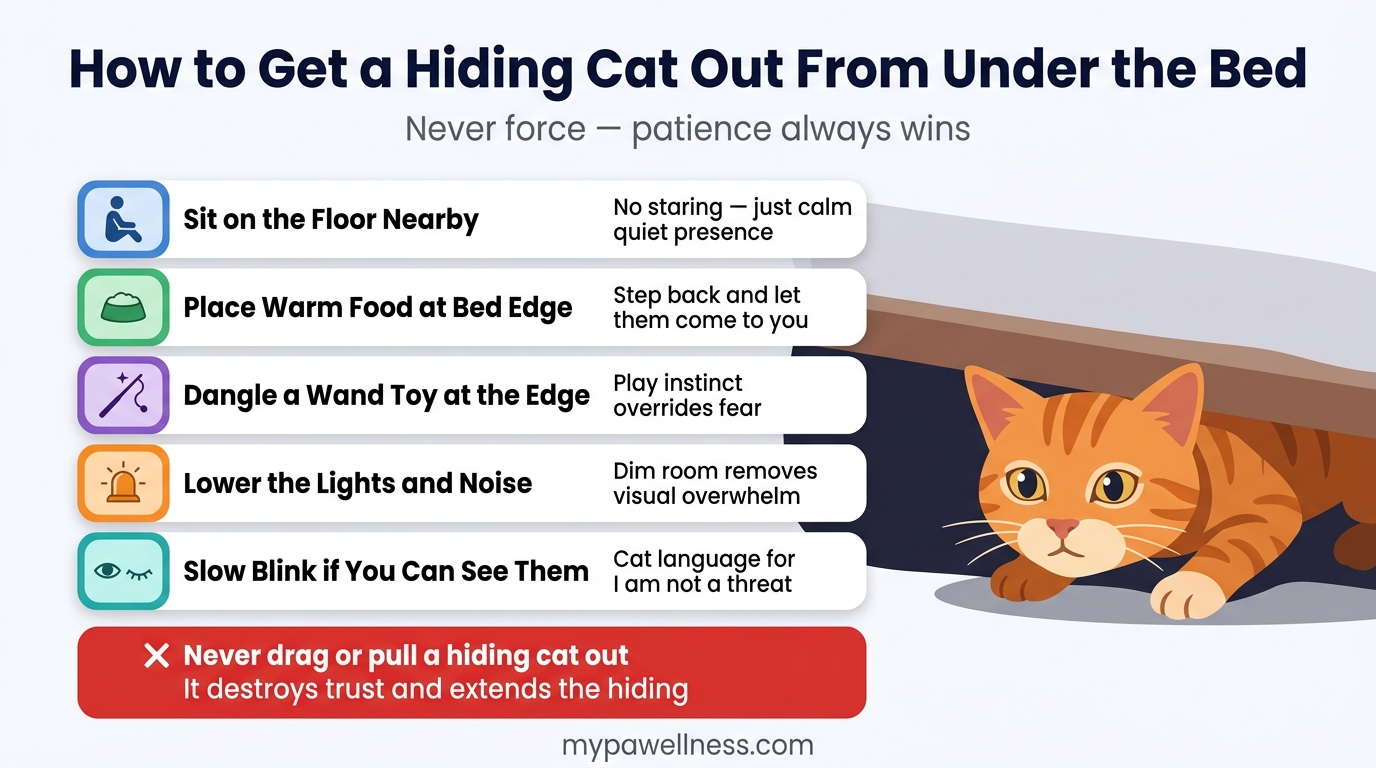
 The instinct is to reach under and pull them out. Don’t — it converts a safe space into a trap, damages trust, and can get you scratched by a frightened cat.
What works instead:
- Lower the pressure in the room — dim the lights, turn off the TV, ask everyone else to leave
- Sit on the floor nearby and ignore them — no staring, no reaching. Let them decide.
- Use smell, not force — warmed wet food or a strong-smelling treat placed a little way from the bed, then step back
- Try a wand toy — dangled near the edge of the bed, not shoved underneath. Play instinct sometimes overrides caution.
- Slow blink at them if you can see them — it reads as non-threatening
- Be patient at night — many shy cats emerge in the dark and quiet when nobody is watching. That still counts.
 If you genuinely must get them out — for a vet appointment, say — the least damaging method is to make under the bed unavailable before they go under it, rather than extracting them once they’re there.
Should You Block Off Under the Bed?
 Usually not — and this surprises people who came here looking for exactly that.
A cat with no safe hiding place doesn’t become a more confident cat; they become a stressed cat with nowhere to go. Hiding spots are genuinely important for feline wellbeing, particularly in multi-cat homes, homes with children, or any busy household. Removing the option tends to make anxiety worse, not better.
The better approach is to give them a hiding place you’re happier with: a covered bed, a cardboard box on its side, a cat cave, or a spot on a high shelf. Cats often prefer high perches to low ones once they feel secure, and an elevated spot gives them the safety of being able to survey the room.
The genuine exceptions are practical ones — a bed frame where a cat could get stuck, or a temporary block before a vet trip. Outside those, leave the den alone and add better options alongside it.
Frequently Asked Questions
No — on its own it’s normal behaviour, not a sign of an unhappy cat. Under the bed is dark, enclosed, and defensible, which is exactly what cats look for in a resting spot. It only becomes a concern if it’s a sudden change, if it persists without an obvious trigger, or if it comes with other symptoms like not eating.
Yes, and it’s often the first sign. Cats instinctively conceal weakness, so withdrawing to a quiet dark place can appear before any obvious physical symptom. That’s why a sudden change in hiding behaviour — especially in a cat who never hid before — deserves attention even if nothing else looks wrong yet.
Often several days, sometimes a couple of weeks for a particularly shy or previously stray cat. That’s normal decompression. What matters more than the hiding is whether they’re eating, drinking, and using the litter box — often overnight when the house is quiet. If they’re doing those things, give them time.
If there’s an obvious trigger — new people, a move, a loud event, a recent vet visit — it’s likely stress, and they’ll emerge as things settle. If there’s no trigger, or they won’t come out even for food, that shifts toward illness or pain and is worth a vet visit rather than waiting.
No. Forcing a cat out of a hiding place teaches them the space isn’t safe and that you’re the reason — which damages trust and usually extends the hiding. Use food, quiet presence, and patience instead. The exception is a genuine need like a vet appointment, and even then, blocking access beforehand is gentler than extracting them.
The Bottom Line
Cat hiding under bed behaviour is usually a cat doing something perfectly normal: finding a dark, enclosed, defensible place to feel safe. For a new or newly adopted cat especially, it’s expected, and it takes days rather than hours.
What changes the picture is context. Sudden hiding in a cat who never hid before, hiding that outlasts its trigger, or hiding alongside not eating, vomiting, or lethargy — those are the versions worth acting on. The simplest rule to carry: hiding alone is usually fine, hiding plus a second symptom is a vet call.

Related Articles
My Cat Is Not Eating or Drinking and Very Weak
Hiding plus not eating is the combination to act on.
My Cat Is Lethargic But Eating and Drinking
Withdrawal and low energy often appear together.