How long is a cat pregnant for? Approximately 63 to 67 days, or about 9 weeks — roughly 2 months from mating to kittens. In days, the average is 65, though healthy pregnancies can range from 60 to 72 days.
Before I adopted my cats, a friend’s outdoor cat became pregnant unexpectedly. Watching the entire 9-week process from early signs to delivery taught me exactly what to expect at each stage — and what most owners panic about unnecessarily versus what actually needs a vet.
A cat’s pregnancy lasts 63 to 67 days (about 9 weeks or roughly 2 months). In months, that’s approximately 2 months and 1 week. In weeks, about 9. First-time mothers may go slightly longer. If pregnancy exceeds 70 days, contact your vet.
How Long Is a Cat Pregnant — Timeline at a Glance
| Measurement | Duration |
|---|---|
| In days | 63–67 days (average 65) |
| In weeks | About 9 weeks |
| In months | About 2 months and 1 week |
| Range (normal) | 60–72 days |
| First-time mothers | May go 1–3 days longer |
| When to worry | Beyond 70 days — call vet |
Early Signs a Cat Is Pregnant
Early signs typically appear within the first 2–3 weeks after mating. Most owners miss them because they are subtle:
- Pink, enlarged nipples (“pinking up”) — the earliest visible sign, usually noticeable around days 15–18. Nipples become darker pink and slightly swollen.
- Morning sickness — some cats vomit occasionally during weeks 3–4. This is mild and temporary. Related: Cat Vomiting White Foam.
- Increased appetite — your cat may eat 25–50% more than usual starting around week 3
- Behavioral changes — increased affection, seeking more attention, or becoming quieter than usual
- Weight gain — gradual at first, becoming obvious by week 5–6
- Sleeping more — the body diverts energy to growing kittens
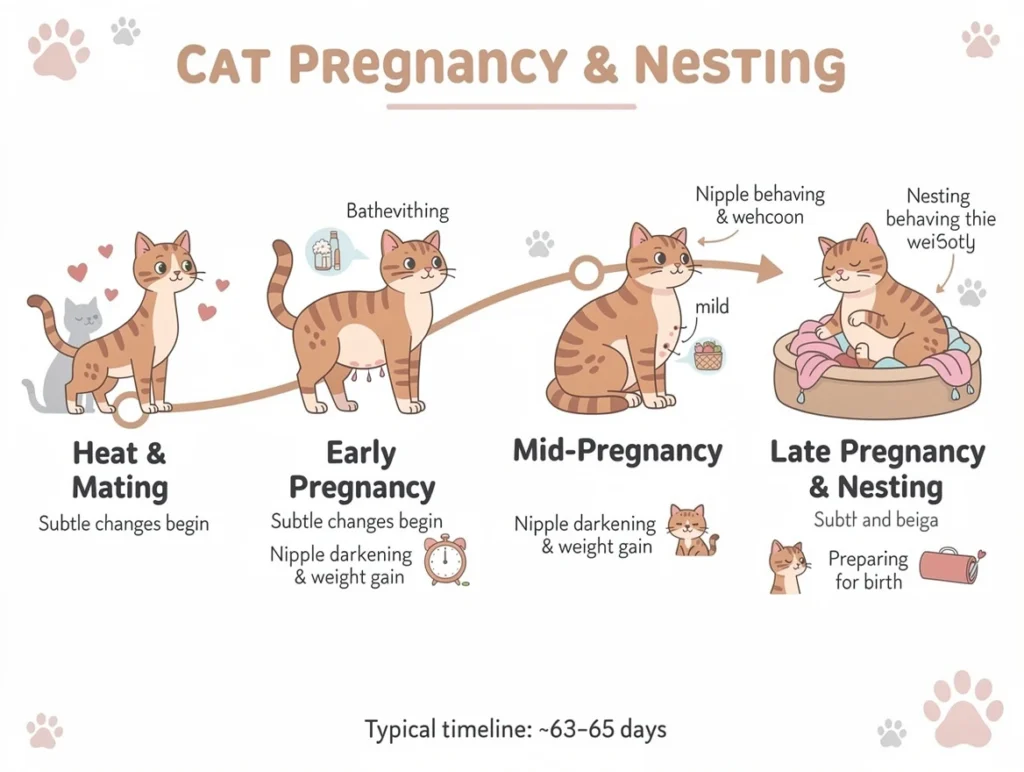
Pregnant Cat Symptoms Week by Week — Stages of Cat Pregnancy
Here is what to expect at each stage of cat pregnancy, and what happens along the way.
| Week | Days | What’s Happening | What You’ll Notice |
|---|---|---|---|
| Week 1–2 | 1–14 | Fertilized eggs travel to uterus and implant | No visible signs yet. Cat acts completely normal. |
| Week 3 | 15–21 | Embryos developing, nipples begin changing | Nipples turn pink and enlarge. Possible mild nausea. Slight appetite increase. |
| Week 4 | 22–28 | Embryos now fetus-sized, heartbeats detectable on ultrasound | Vet can confirm pregnancy. Morning sickness may occur. Belly starting to fill out. |
| Week 5 | 29–35 | Rapid fetal growth, organs developing | Noticeable weight gain and belly expansion. Increased appetite — feed 25% more. |
| Week 6 | 36–42 | Kittens developing fur, claws, and skeleton | Belly clearly rounded and visibly distended. Cat may slow down. |
| Week 7 | 43–49 | Kittens almost fully formed, gaining weight rapidly | You may feel kittens moving when you gently place your hand on the belly. X-ray can count kittens now. |
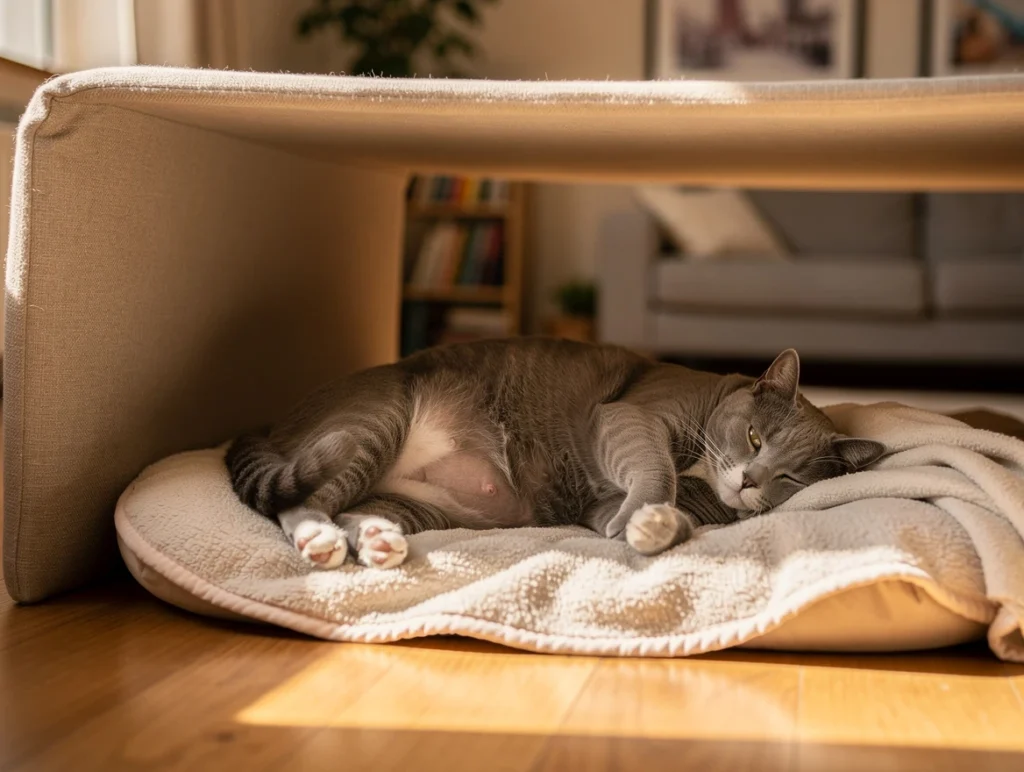
| Week 8 | 50–56 | Kittens preparing for birth, shifting into position | Cat’s belly is large and low. Nipples may leak milk. Cat starts seeking nesting spots. Appetite may decrease slightly. |
| Week 9 | 57–67 | Final development, birth imminent | Nesting behavior intensifies. Temperature drops 1–2°F (12–24 hours before labor). Restlessness, pacing, vocalization = labor starting. |
Cat Giving Birth for the First Time
First-time births can be longer and more unpredictable than subsequent pregnancies. First-time mothers may:
- Go 1–3 days past the average 65-day mark — a first pregnancy typically runs 65–68 days
- Show more anxiety and restlessness before labor
- Take longer between delivering each kitten (30–60 minutes vs 10–30 minutes for experienced mothers)
- Seem confused about what to do with the first kitten — some first-time mothers need a moment before instinct kicks in
- More than 1 hour of active straining with no kitten delivered
- More than 4 hours between kittens when you know more are coming
- Green or black discharge before the first kitten
- Cat is extremely lethargic, not pushing, or seems in distress
- A kitten is stuck halfway out for more than 10 minutes
- Pregnancy exceeds 70 days with no signs of labor
How Many Times Can a Cat Get Pregnant in a Year
Up to 3 times per year, potentially producing 12–15 kittens annually. Cats are induced ovulators and can go into heat as early as 2–3 weeks after giving birth. There is no “recovery period” that prevents pregnancy — a nursing cat can become pregnant again almost immediately.
This is exactly why spaying is so critical. One unspayed female cat and her offspring can theoretically produce over 400,000 cats in 7 years. Related: How Much Wet Food to Feed a Cat — feeding a pregnant or nursing cat requires significantly more calories.
Until What Age Can a Cat Get Pregnant
Technically, cats can become pregnant throughout their entire life. Unlike humans, cats do not go through menopause. However, fertility decreases significantly after age 8–10, and pregnancies in senior cats carry much higher risks of complications, stillbirths, and health problems for both mother and kittens.
Most vets strongly recommend spaying before the first heat (around 4–5 months of age) to prevent unwanted pregnancies and reduce the risk of mammary cancer by up to 90%.
How to Tell How Far Along Your Cat Is
Use these milestones to estimate the stage:
| Sign | Approximate Stage |
|---|---|
| Nipples pink and slightly enlarged | 2–3 weeks pregnant |
| Mild nausea / appetite change | 3–4 weeks |
| Belly starting to fill out | 4–5 weeks |
| Belly clearly rounded, weight gain obvious | 5–6 weeks |
| Kittens can be felt moving | 7–8 weeks |
| Nesting behavior, milk from nipples | 8–9 weeks (birth imminent) |
| Temperature drop, restlessness, vocalization | 12–24 hours before labor |
What to Feed a Pregnant Cat
- Weeks 1–4: Regular food, slightly increased portions (+25%)
- Weeks 5–9: Switch to kitten food — it has higher calories, protein, and calcium that pregnant cats need
- Fresh water always available — pregnant cats drink more
- Feed smaller, more frequent meals — the growing uterus compresses the stomach. 3–4 smaller meals per day is better than 2 large ones.
- Continue kitten food through nursing — milk production requires enormous energy. Related: How Often Should I Feed My Cat Wet Food.
When to See the Vet
🩺 See Your Vet If:
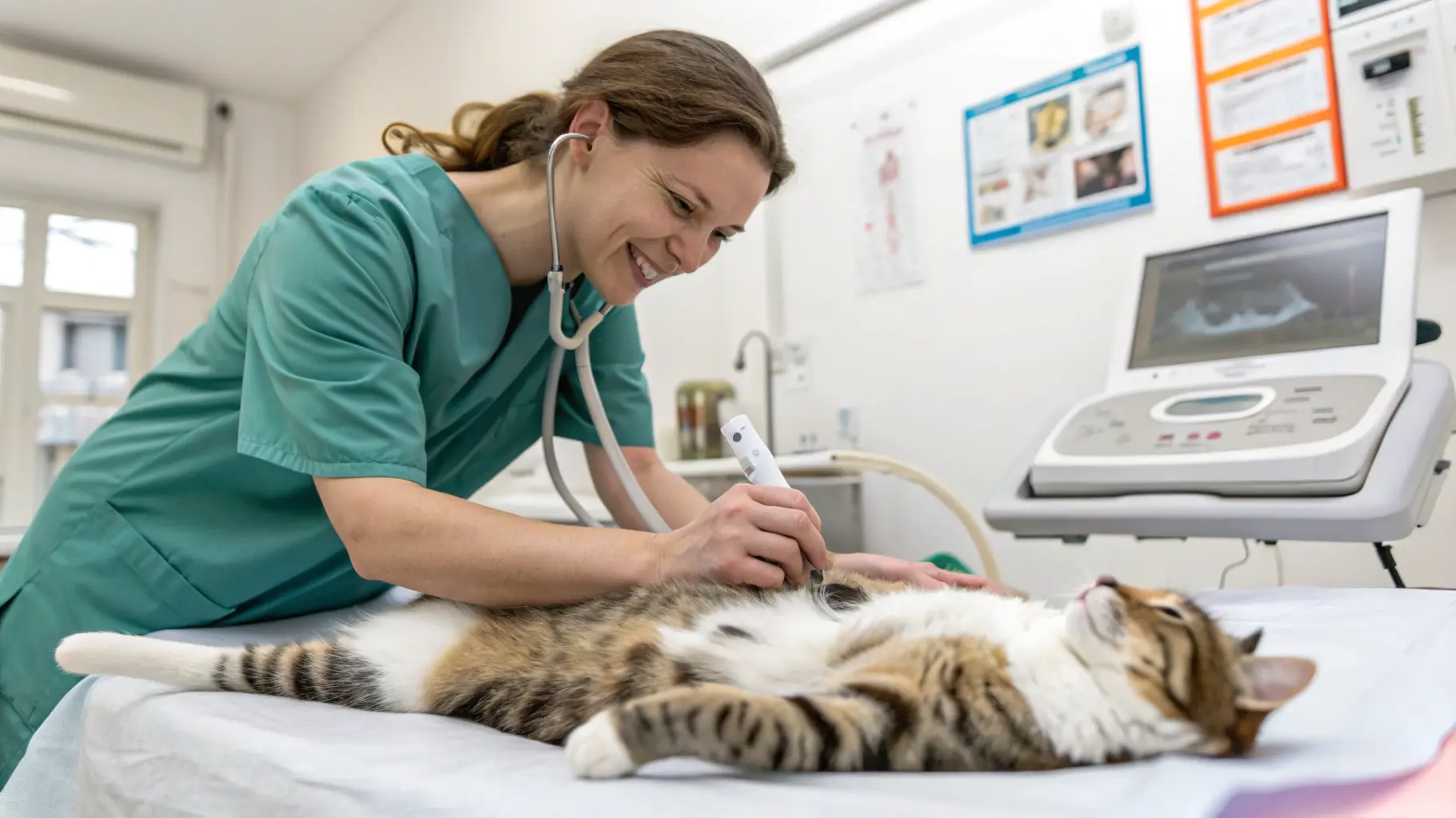
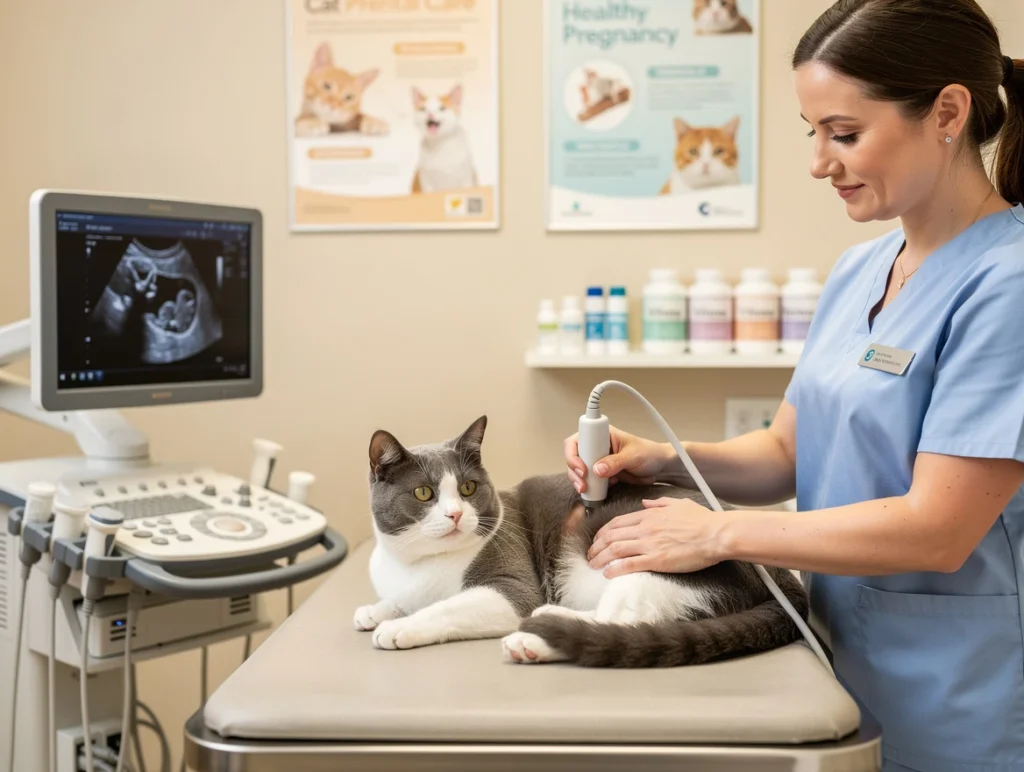
- You suspect pregnancy — confirm with ultrasound at day 21–25
- Get an X-ray after day 42 to count kittens (so you know when delivery is complete)
- Pregnancy exceeds 70 days with no signs of labor
- Vaginal bleeding or foul-smelling discharge at any point during pregnancy
- Cat stops eating for more than 24 hours. Related: My Cat Is Not Eating or Drinking and Very Weak
- Sudden lethargy, fever, or signs of illness
- Any complications during labor (straining without progress, kitten stuck)
Common Mistakes
- Not confirming pregnancy with a vet — false pregnancies happen. Confirm with ultrasound.
- Over-handling the belly — gentle touch is fine, but pressing or squeezing can harm developing kittens
- Feeding regular food through the entire pregnancy — switch to kitten food from week 5 for proper nutrition
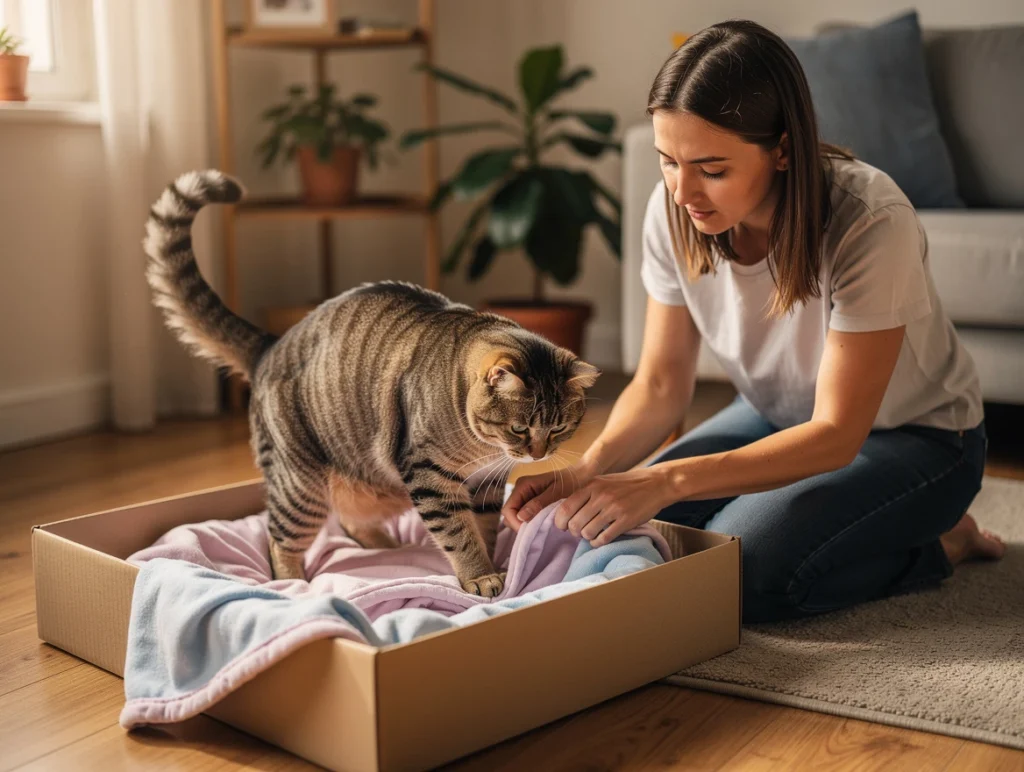
- Not preparing a nesting area — provide a quiet, warm, private box 1–2 weeks before the due date
- Panicking during labor — most cats deliver without human help. Stay nearby, stay calm, intervene only if something goes wrong.
- Not spaying after delivery — cats can get pregnant again within 2–3 weeks of giving birth
Frequently Asked Questions
63 to 67 days, or about 9 weeks. The average is 65 days. Normal range extends from 60 to 72 days. If pregnancy exceeds 70 days with no signs of labor, contact your vet.
About 2 months and 1 week — just over 2 months, which is significantly shorter than human pregnancy.
63 to 67 days from the day of mating. Signs that birth is imminent include nesting behavior, nipple milk leaking, temperature drop, and restlessness within 12–24 hours of labor.
First-time mothers average 65–68 days — slightly longer than experienced mothers. First labors also tend to be slower, with more time between kittens.
At 8 weeks, the belly is large and low-hanging. Nipples are prominent and may leak milk. The cat moves more slowly, sleeps more, and actively seeks out quiet nesting spots. You can usually feel kittens moving when you place your hand gently on the belly.
Key milestones: pink nipples at 2–3 weeks, belly filling out at 4–5 weeks, clearly rounded belly at 5–6 weeks, kittens moving at 7–8 weeks, and nesting behavior at 8–9 weeks. An ultrasound gives the most accurate estimate.
Up to 3 times per year. Cats can go into heat 2–3 weeks after giving birth. One unspayed female can produce 12–15 kittens annually.
Cats can become pregnant throughout their entire life — they never go through menopause. However, fertility drops significantly after age 8–10, and senior pregnancies carry much higher risks.
Fertilization and implantation (weeks 1–2), early development with nipple changes (week 3), organ formation (weeks 4–5), rapid growth (weeks 6–7), final development and nesting (weeks 8–9), then labor and delivery.
The earliest signs are pink, enlarged nipples around day 15–18, mild morning sickness, increased appetite, more affectionate behavior, and slight weight gain. A vet can confirm pregnancy by ultrasound at day 21–25.
The Bottom Line
A cat’s pregnancy lasts about 65 days, or 9 weeks. The first signs appear around week 3, the belly becomes obvious by week 5–6, and nesting behavior signals birth is days away. Switch to kitten food from week 5, prepare a quiet nesting area, and get an X-ray after day 42 to count kittens. Most cats deliver without help — stay nearby, stay calm, and call the vet only if labor stalls or complications arise. After delivery, discuss spaying with your vet to prevent another pregnancy within weeks. Related: How Often Should I Feed My Cat Wet Food — feeding schedules matter even more during pregnancy. Also: How Often Should I Bathe My Cat — grooming a pregnant cat safely.