Laryngitis in cats is inflammation of the larynx — the voice box — and the first sign is almost always a change in your cat’s meow. It goes hoarse, raspy, quiet, or disappears entirely. Most cases are mild and clear up on their own, but a few point to something more serious, and the difference is worth knowing.
Laryngitis in cats is an inflamed voice box, usually caused by an upper respiratory infection, an irritant, or vocal strain. The main sign is a hoarse, raspy, or lost meow. Mild cases in a cat that’s eating and breathing normally often resolve in a few days to a week. See a vet if your cat has any trouble breathing, stops eating, or the voice change lasts more than about a week — and go the same day for any breathing difficulty.
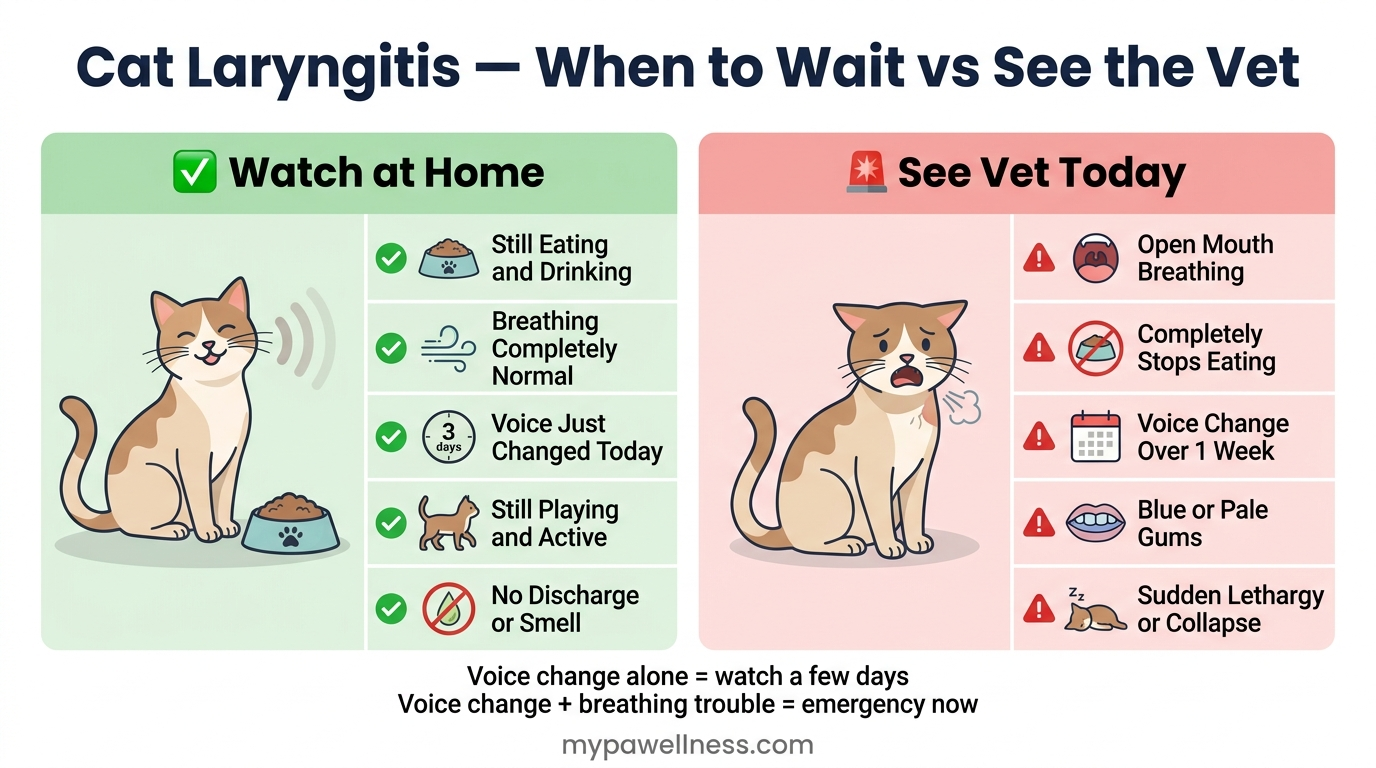
- Any difficulty breathing — open-mouth breathing, gasping, or noisy laboured breaths
- Blue or pale gums
- Complete refusal to eat or drink
- Drooling with obvious difficulty swallowing (possible foreign object)
- Sudden collapse or extreme lethargy
A voice change alone is rarely an emergency. A voice change plus any breathing trouble is — the larynx sits at the entrance to the airway, so swelling there can restrict breathing.
What Laryngitis in Cats Actually Is
The larynx is your cat’s voice box — the structure at the top of the windpipe that produces the meow and also acts as a gateway protecting the airway when they swallow. When it becomes inflamed and swollen, the vocal folds can’t vibrate normally, so the sound changes. That’s laryngitis.
Because the larynx sits right at the entrance to the airway, significant swelling can do more than change the voice — it can make breathing harder. That’s why the one thing to watch above all others is your cat’s breathing, not the meow itself.
Signs and What It Sounds Like
The voice change is the giveaway, but there are usually a few signs together:
| Sign | What You Notice |
|---|---|
| Voice change | A hoarse, raspy, whispery, or completely lost meow — often the first and clearest sign |
| Cough | A short, dry, or harsh cough |
| Noisy breathing | Wheezing, raspy, or high-pitched sounds when breathing |
| Posture | Standing with the head lowered and the mouth slightly open in more uncomfortable cases |
| Swallowing | Reluctance to eat, or discomfort when swallowing |
| Other URI signs | Sneezing, runny nose, or watery eyes if a respiratory infection is the cause |
What laryngitis sounds like: owners most often describe it as their cat “losing their voice” — the meow comes out as a croak, a squeak, a whisper, or nothing at all despite the cat clearly trying to vocalise. If your cat’s meow has gone raspy rather than silent, our guide on a weak and raspy meow covers the full range of causes.
What Causes Laryngitis in Cats
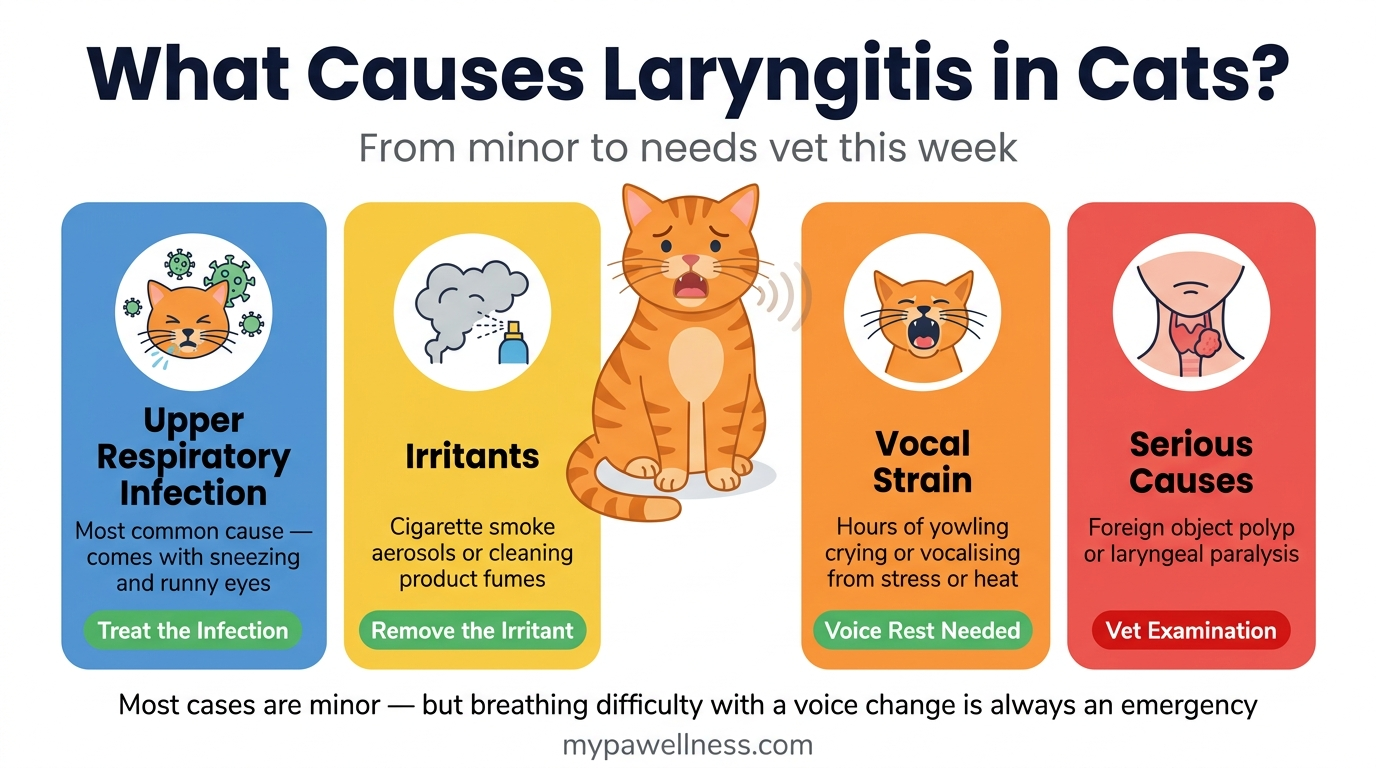
Upper respiratory infection (most common)
Viruses like feline calicivirus and feline herpesvirus (feline rhinotracheitis) are the most common cause. The same infection behind a cat’s “cold” inflames the larynx along with the nose and throat. This is why laryngitis so often comes with sneezing and runny eyes. Related: Why Is My Cat Sneezing So Much.
Irritants
Inhaling smoke, dust, aerosol sprays, or harsh cleaning-product fumes can inflame the larynx directly. Cats in homes with cigarette smoke or heavy use of scented sprays are more prone to it.
Vocal strain
Prolonged, intense meowing, yowling, or crying — a cat in heat, a cat that howled for hours in a carrier, or one that’s been vocalising from stress — can strain and inflame the larynx, much like a person losing their voice after shouting. This is also the honest answer to whether hissing can cause it: sustained, forceful vocalising of any kind can, though a few hisses won’t.
Serious causes (less common, but why a vet visit matters)
Occasionally a hoarse voice points to something that isn’t simple inflammation: a foreign object lodged in the throat, a growth or polyp, or laryngeal paralysis — a separate condition where the nerves controlling the larynx stop working properly. Laryngeal paralysis is more serious than laryngitis, can cause real breathing difficulty, and often needs specific veterinary treatment rather than resolving on its own. A vet exam is how these get told apart from ordinary laryngitis.
Hoarse Voice but No Other Symptoms
If your cat’s voice has changed but they’re otherwise completely normal — eating, drinking, playing, breathing easily — the most likely explanations are mild vocal strain or the very early stage of a respiratory infection. This is the least worrying version.
The reasonable approach here is to watch closely for 2–3 days. If the voice is the only thing that’s off and your cat is comfortable, mild cases often settle on their own. But keep checking their breathing and appetite, because those are the signals that tell you whether it’s staying mild or turning into something that needs a vet. A voice change that hasn’t improved after about a week, even with no other symptoms, is worth a vet visit to find out why.
Is Laryngitis in Cats Contagious?
Laryngitis itself isn’t contagious — but the most common cause often is. When laryngitis comes from feline calicivirus or herpesvirus, those viruses spread readily between cats through sneezing, shared bowls, and close contact. So in a multi-cat household, a cat with infection-related laryngitis can pass the underlying virus to the others, who may then develop their own symptoms.
If one cat has a hoarse voice alongside sneezing or eye discharge, it’s sensible to watch the others for the same signs. Laryngitis caused by an irritant or vocal strain, on the other hand, carries no contagion risk at all.
Is Laryngitis in Cats Deadly or Serious?
In the great majority of cases, no — mild laryngitis is uncomfortable but not dangerous, and it resolves with time or simple supportive care. The reason it’s worth taking seriously anyway is the airway. Because the inflamed larynx sits at the airway’s entrance, severe swelling can, in rare cases, restrict breathing — and that’s the situation that becomes an emergency.
The practical rule: a voice change is a monitor-and-wait situation; any breathing difficulty is a go-to-the-vet-now situation. Watch the breathing, not the meow.
What You Can Do at Home
Home care is appropriate only for mild cases — a cat with a hoarse voice that is eating, drinking, and breathing normally. It supports recovery; it doesn’t treat an underlying infection or a serious cause.
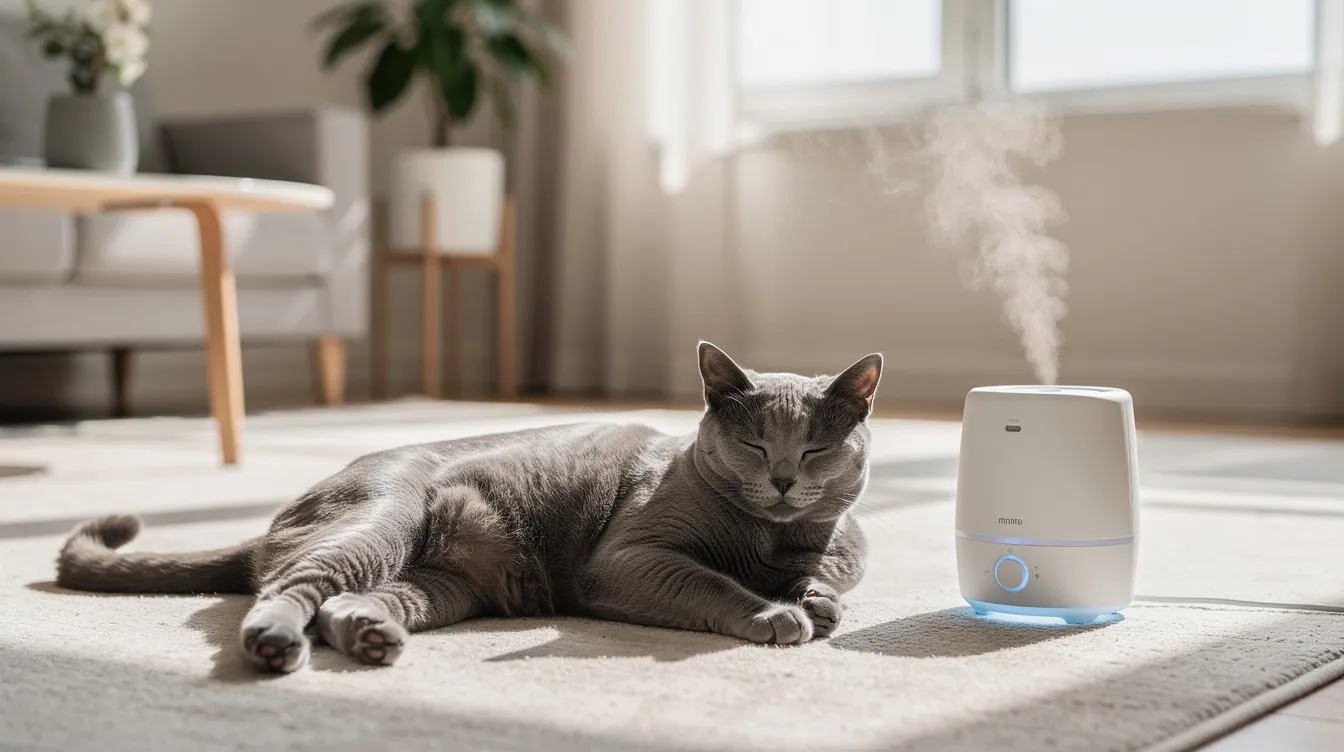
- Add moisture to the air — a humidifier, or letting your cat sit in a steamy bathroom while you run a hot shower for 10–15 minutes, soothes an irritated larynx
- Offer soft, wet food — easier and less painful to swallow than dry kibble while the throat is sore. Warming it slightly boosts the aroma and encourages a reluctant cat to eat
- Remove irritants — no smoking around the cat, pause scented sprays and aerosols, and keep dust down
- Encourage rest and reduce stress — less vocalising gives the larynx time to settle. Keep the environment calm
- Keep water easily available — hydration helps; a fountain sometimes encourages drinking more than a bowl
What a Vet Does
A vet’s first job is finding the cause, because that determines the treatment. There’s no single “laryngitis medicine” — what’s prescribed depends entirely on what’s behind it, which is exactly why a hoarse voice that isn’t improving needs a real diagnosis rather than a guessed remedy.
- Examination — listening to the chest and airway, checking the mouth and throat, and looking for signs of infection or a foreign object
- Identifying the cause — a respiratory infection, an irritant, strain, or something structural like a polyp or laryngeal paralysis are all managed differently
- Treatment matched to the cause — this may involve anti-inflammatory medication, or antibiotics if a bacterial infection is involved, but only your vet can decide what’s appropriate for your specific cat. Antibiotics do nothing for a viral or irritant cause, which is one reason self-treating is a bad idea
- Further tests if needed — sedated airway exam or imaging for cases that don’t fit a simple picture or don’t improve
If your cat has any breathing difficulty, the vet visit isn’t optional or “within a week” — it’s the same day.
Recovery Time
 Mild laryngitis — from a minor irritant or vocal strain — often improves within a few days and resolves within about a week with rest and supportive care. When it’s tied to an upper respiratory infection, recovery usually tracks the infection itself, commonly one to three weeks, and treating the infection is what resolves the voice.
Cases that drag on beyond that, or that involve a structural cause like a polyp or laryngeal paralysis, take longer and depend on treating the specific underlying problem. If your cat’s voice hasn’t started improving within a week or so, that’s the signal to have a vet look rather than continuing to wait.
Frequently Asked Questions
Yes — most cats recover fully. Mild cases from strain or a minor irritant often clear on their own within a week. Infection-related cases recover once the infection is treated. The cases that need more are the less common structural ones, which is why a voice change that doesn’t improve is worth a vet check.
The clearest sign is a hoarse, raspy, or lost meow, often with a dry cough and sometimes noisy breathing. If it comes with sneezing and watery eyes, a respiratory infection is the likely cause. A vet can confirm laryngitis and rule out the more serious lookalikes with an exam.
Sustained, forceful vocalising — long bouts of yowling, crying, or yes, prolonged hissing — can strain and inflame the larynx, the same way shouting for hours makes a person hoarse. A few normal hisses won’t do it; it takes prolonged vocal strain.
Mild cases often improve within a few days and resolve in about a week. Infection-related laryngitis usually lasts one to three weeks and clears as the infection is treated. Anything lasting longer warrants a vet visit to check for a structural cause.
No breed is officially predisposed to laryngitis itself, but flat-faced (brachycephalic) breeds like Persians and Himalayans have narrower, more crowded airways, which can make any throat irritation more noticeable and sometimes harder on their breathing. In these cats especially, a voice change with any breathing effort is worth a prompter vet check.
Home care can soothe a mild case — humidified air, soft food, removing irritants, and rest — but it doesn’t “cure” laryngitis, because that depends on the cause. An infection needs the infection treated; a serious cause needs a vet. Home comfort measures are for mild cases in a cat that’s otherwise eating and breathing normally.
The Bottom Line
Laryngitis in cats is usually a minor, temporary problem — an inflamed voice box that leaves your cat hoarse for a few days to a week or two. Most cases come from a respiratory infection, an irritant, or overuse of the voice, and most resolve with time and simple home comfort.
The one thing that turns it from minor to urgent is breathing. Watch your cat’s breathing and appetite, not just their meow: a hoarse voice can wait a few days, but any breathing difficulty, refusal to eat, or a voice change that lasts more than about a week means it’s time to see the vet.
Related Articles
Why Is My Cat Sneezing So Much
Respiratory infections cause both sneezing and laryngitis.