Published: March 2026 | Last Updated: March 2026 | Read Time: 10 minutes
The signs your cat loves you are real, scientifically documented, and happening around you every single day — you just need to know what to look for. I’ve lived with four cats for years, and even I had to learn that cats don’t express love the way dogs do. They’re subtle. They’re deliberate. And when you understand their language, the signs your cat loves you become impossible to miss. This guide breaks down the 7 most meaningful ones — backed by research and honest personal experience.
Quick Answer: Signs Your Cat Loves You
| Sign | What It Means |
|---|---|
| Slow blinking at you | “I trust you completely” |
| Headbutting or bunting | “You’re part of my family” |
| Kneading on you | Deepest comfort and security |
| Showing you their belly | Total vulnerability and trust |
| Bringing you gifts | “I want to provide for you” |
| Sleeping on or near you | You are their safe place |
| Touching your face with their paw | Deliberate, chosen affection |
Do Cats Actually Love Their Owners?
For years, people assumed cats were aloof and self-serving — that they tolerated humans for food and warmth but felt nothing deeper. The science has since proven otherwise.
Research from the University of Lincoln’s School of Life Sciences found that cats form genuine secure attachment bonds with their owners, comparable to the bonds children form with parents. Cats with secure attachments showed lower stress in unfamiliar environments when their owner was present — and returned to their owner when frightened rather than hiding or fleeing.
According to the American Association of Feline Practitioners, cats are capable of complex social bonding and express affection through a range of behavioral signals that are easy to miss if you don’t know what you’re looking for.
The signs your cat loves you aren’t loud or obvious. They’re quiet, deliberate, and deeply meaningful in the feline world. Here are the seven that matter most.
7 Signs Your Cat Loves You
Sign 1: The Slow Blink — The “I Love You” of Cat Language
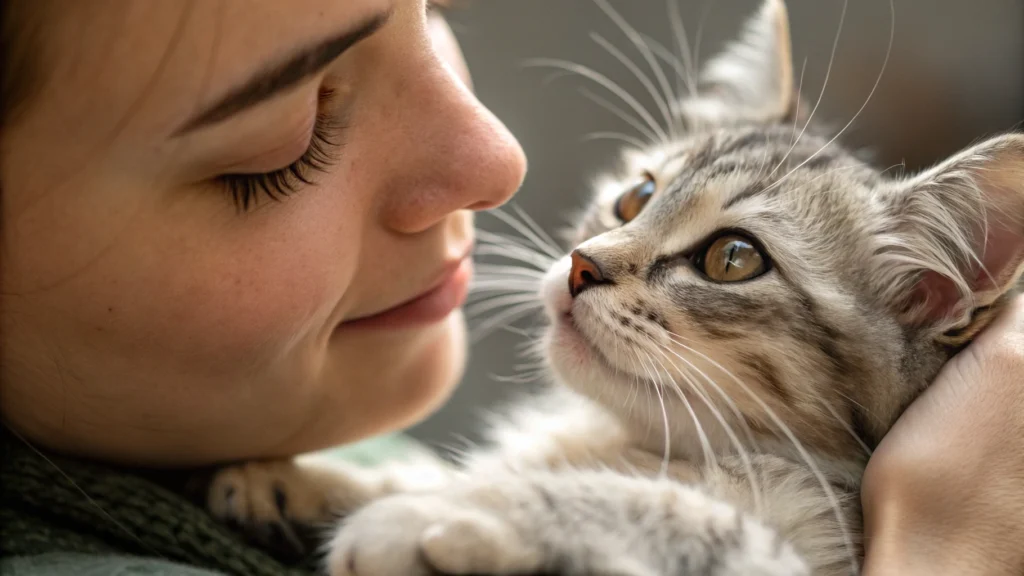
If your cat holds eye contact with you and then slowly, deliberately closes their eyes and reopens them — that is one of the most direct signs your cat loves you that exists in feline communication.
In cat language, direct prolonged eye contact is a threat signal. A cat who makes soft eye contact and then slowly closes their eyes is doing something profoundly trusting: they’re choosing to be momentarily “blind” in your presence. That only happens with someone they feel completely safe with.
Research from the University of Sussex found that cats respond positively to slow blinking from humans and are significantly more likely to approach a person who slow blinks at them versus one who maintains a neutral expression. The slow blink works both ways — it’s a genuine exchange of trust.
I have four cats. My oldest, a grey tabby named Mochi, slow blinks at me every single morning when I sit down with my coffee. It took me two years to understand what she was saying. Now I slow blink back, every time.
What to do: When your cat slow blinks at you, slow blink back. Hold soft eye contact, blink slowly, look away slightly. You’re telling them: I see you. I trust you too.
Sign 2: Headbutting and Bunting
When your cat walks up to you and presses their head or cheek against your face, hand, or leg — that’s called bunting, and it’s one of the clearest signs your cat loves you and considers you part of their social group.
Cats have scent glands in their cheeks, forehead, and chin. Bunting deposits their scent on you — not in a possessive way, but in the way a family member leaves their coat on your chair. You smell like them. You smell like home. In feline social groups, bunting is reserved for cats and people they genuinely bond with.
My most independent cat — a rescue named Luna who spent her first year barely leaving the bedroom — bumped her head against my hand for the first time after about 14 months. I didn’t move for five full minutes. She did it three more times that evening. That was the beginning of everything between us.
What to do: Let it happen on her terms. Offer your hand or forehead slowly and let her close the distance. Never push toward her — let her choose to make contact.
Sign 3: Kneading — The Deepest Comfort Behavior
When your cat pushes their paws rhythmically against your lap, a blanket, or your arm — that’s kneading, and it’s one of the most emotionally significant signs your cat loves you.
Kneading originates in kittenhood. Kittens knead their mother’s belly to stimulate milk flow — it’s associated with warmth, nourishment, and complete safety. When an adult cat kneads on you, they’re accessing that same deep emotional state. You have become, in the most fundamental sense, their safe place.
According to the Cornell Feline Health Center, kneading in adult cats is a retained comfort behavior strongly associated with feelings of security and contentment. A cat who kneads on a specific person has placed that person in their innermost circle of trust.
Two of my cats knead. One does it gently — barely any pressure, almost meditative. The other does it with full commitment, claws partially extended, purring so loudly I can hear it from across the room. Both are saying exactly the same thing.
What to do: Let them knead. Keep a thick blanket on your lap if the claws are an issue — but never pull away abruptly or react with alarm. You’re receiving a gift.
Sign 4: Showing You Their Belly
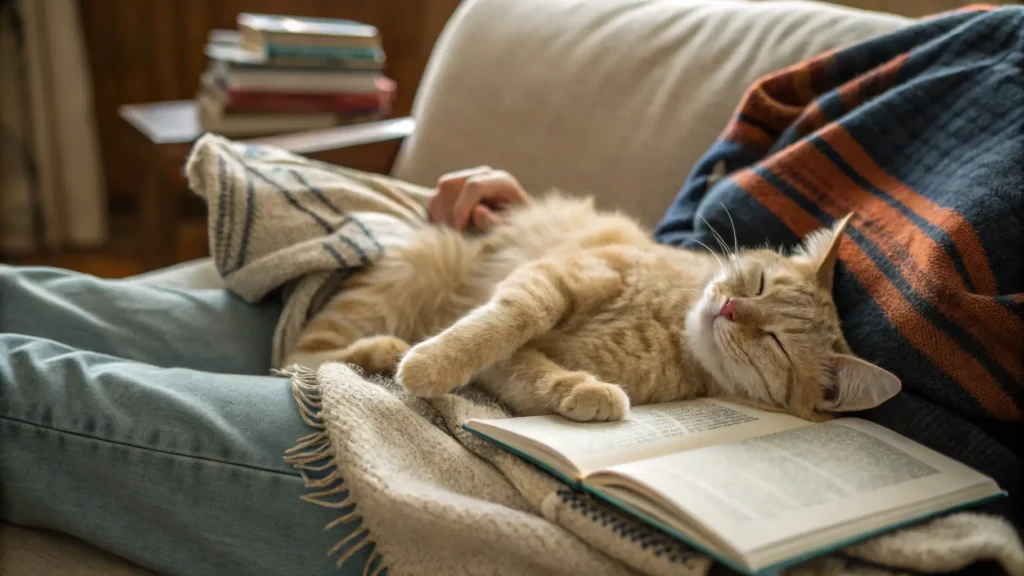
A cat rolling over and exposing their belly in your presence is one of the most misunderstood — and most significant — signs your cat loves you.
The belly is the most vulnerable part of a cat’s body. In the wild, exposing it means exposing vital organs to potential threat. A cat who rolls over and shows you their belly is communicating something few creatures say to anyone: I am completely safe here. I am not afraid of you.
Critical note: This is not necessarily an invitation to touch the belly. Many cats who show their belly will react strongly if you touch it — the belly display is an emotional message, not a petting request. Read your individual cat’s signals before reaching in.
The cats who are true belly-shower-and-touchers are communicating the deepest level of physical trust. But even the show alone — belly exposed, legs in the air, looking at you — is among the most genuine signs your cat loves you.
Sign 5: Bringing You Gifts
If your cat has ever deposited a toy, a dead mouse, or a particularly prized object at your feet — congratulations. That is one of the signs your cat loves you that most people misread as disturbing rather than touching.
Cats in social groups share prey with their trusted companions. It’s a care behavior — “I caught something and I want you to have it.” Indoor cats redirect this toward toys or household objects because real prey isn’t available. But the impulse is identical: sharing resources with someone you love and want to provide for.
One of my cats brings me hair ties. Every morning. She carries one from wherever she’s stashed them, drops it near my feet, and looks at me with what I can only describe as expectation. I make a point of picking it up and saying thank you every time. She’s been doing this for three years.
What to do: Acknowledge the gift. Pick it up, say something warm, let your cat see that you received it. Ignoring the gift or reacting with disgust communicates that the gesture didn’t land — and cats notice.
Sign 6: Sleeping On or Near You
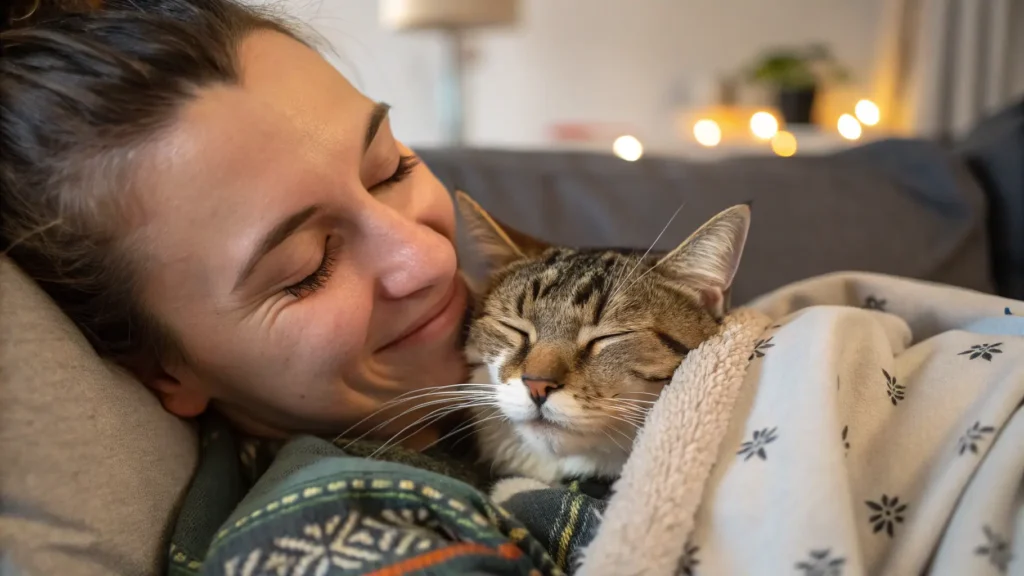
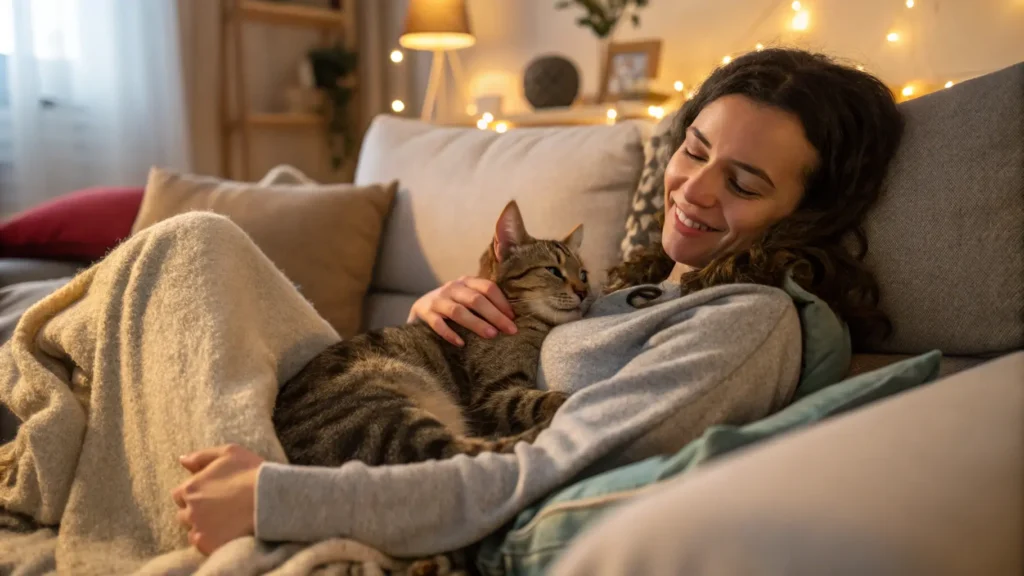
Where a cat chooses to sleep tells you everything about who they trust. Cats are vulnerable when they sleep — they know this instinctively. The location they choose for sleep is the location where they feel safest.
A cat who sleeps directly on you — on your chest, your legs, your feet — is placing their most vulnerable state in your care. A cat who consistently sleeps near you, even if not touching, is keeping you within the radius of their safe zone.
My cat Biscuit has slept on my feet every single night for four years. He shifts when I shift. He wakes when I wake. He’s not just sleeping near me — he’s chosen me as his anchor point, the fixed star he orients around. That’s love. It might be the clearest version of it.
Signs of cat sleeping love:
- Sleeping directly on your body
- Choosing the spot on the bed closest to you
- Resting their head on your hand or arm
- Moving to stay near you when you change position
- Seeking you out specifically when tired or unwell
Sign 7: Following You and Seeking Your Presence
One of the quieter but most consistent signs your cat loves you is simply this: they want to be where you are.
Cats who follow their owners from room to room — not when it’s mealtime, not when they want something specific, but just to be in the same space — are demonstrating attachment behavior that researchers classify as proximity-seeking. They don’t need anything from you in that moment. They just want to be near you.
This is especially meaningful in cats who are naturally independent or who had difficult early lives. A formerly feral or under-socialized cat who starts following you around has crossed a threshold that took real time and trust to reach.
I noticed my rescue Luna starting to follow me about eighteen months after I adopted her. She’d appear in whatever room I moved to — not demanding attention, just present. Sitting nearby, watching. That shift in behavior was more meaningful to me than any dramatic gesture could have been.
What to do: Don’t make a big deal of it in the moment — that can startle independent cats. Simply continue what you’re doing, speak softly if you notice them, and let them choose how close to get. Consistency is what builds this behavior over time.
How Do You Tell If a Cat Really Loves You?
The difference between a cat who tolerates you and a cat who loves you comes down to one question: does your cat seek you out when they have nothing to gain?
A cat who approaches you only at mealtimes, only when they want the door opened, only when they want warmth — is using you. That’s not love, it’s resource management.
A cat who slow blinks at you when they’re already comfortable and fed, who follows you when there’s no food involved, who chooses to sleep on you when the whole couch is available, who headbutts you when they walk past without stopping for anything — that cat loves you.
The signs your cat loves you are most visible in the moments when they have no practical reason to seek you out.
How Do You Say “I Love You” Back in Cat Language?
Learning the signs your cat loves you is only half the conversation. Here’s how to respond in a language your cat actually understands:
The slow blink exchange: Make soft eye contact, close your eyes slowly, reopen. Turn your head slightly to the side after. This is the most direct “I love you” you can say to a cat.
Let them initiate contact: Offer your hand at nose level and wait. Let them close the distance. Never reach for a cat’s face or grab — always let them choose to engage.
Be predictably calm: Cats attach to people who are emotionally consistent. Loud, unpredictable energy is stressful. Quiet, steady presence builds trust faster than any gesture.
Honor their “no”: When your cat walks away or shows signs of overstimulation — tail flicking, skin rippling, ears rotating back — stop immediately and give them space. A cat who learns that “no” is respected becomes far more willing to say “yes.”
Speak to them: Research suggests cats learn to recognize their owner’s voice and respond to it distinctively. Talking to your cat in a warm, low voice during calm moments reinforces that your presence means safety.
How Do You Tell If Your Cat Is Bonded to You?
Attachment and bonding go deeper than affection. Signs your cat loves you and is genuinely bonded to you specifically include:
- Greeting you at the door — not just on good days, consistently
- Seeking you out when frightened — thunderstorms, strangers, unusual sounds
- Showing reduced stress in your presence — visibly calmer when you’re home
- Preferring you in a multi-person household — choosing your lap, your bed, your company
- Mirroring your emotions — more active when you’re energetic, calmer when you’re still
- Physical contact during vulnerability — sleeping on you, touching your face
According to research cited by the Cornell Feline Health Center, cats with secure human attachments show measurably lower cortisol levels (stress hormone) and better health outcomes over time. The bond isn’t just emotional — it has physiological effects on your cat’s wellbeing.
What Is “I Love You” in Cat Language?
The three clearest ways a cat says “I love you”:
1. The slow blink — Eyes soft, blink slow, presence calm. This is the verbal “I love you.”
2. The head bump — Contact initiated by them, scent shared deliberately. This is “you’re mine and I’m yours.”
3. The purr in your presence — Not all purrs are contentment, but a purr that happens specifically when your cat is near you, relaxed, with no obvious need being met — that’s pure emotional expression.
If you’re wondering whether your cat understands that you love them: yes. Research consistently shows cats distinguish their owner’s voice, scent, and behavioral patterns from those of strangers. They know who you are. They know what you mean to them.
Is There a 3-3-3 Rule for Cats?
The 3-3-3 rule is commonly referenced for newly adopted dogs, but it applies well to cats too — particularly rescues. It describes the adjustment timeline:
- First 3 days: Overwhelmed and hiding. Don’t push interaction. Let them decompress.
- First 3 weeks: Starting to understand the routine. May begin showing small trust signals.
- First 3 months: Beginning to feel at home. True personality starts to emerge. Attachment behaviors begin.
The signs your cat loves you in a rescue situation often don’t appear until the 3-month mark or later. Luna — my most guarded cat — took closer to 6 months to show consistent affection. The 3-3-3 rule is a minimum, not a deadline.
Frequently Asked Questions
What are the signs your cat loves you the most? The most significant signs your cat loves you are slow blinking, kneading, headbutting, and consistently sleeping on or near you. These behaviors require trust and vulnerability — they’re not random. A cat who does multiple of these with you specifically has chosen you as their person.
How do you know if a cat is happy with you? Signs of a happy, content cat who feels secure with you include: soft, relaxed body posture, slow blinking, purring without an obvious need, kneading, a tail held upright with a slight curve at the tip (called the “question mark tail”), and choosing to be near you without being prompted.
Signs your cat loves you even if they seem aloof? Aloof cats show love differently but no less genuinely. Watch for: sitting in the same room without seeking contact, orienting their body toward you while appearing to ignore you, sleeping near you but not on you, slow blinking from a distance, and greeting you with a raised tail tip when you come home. These are all signs your cat loves you — just expressed in a quieter register.
Can cats tell if you love them? Yes — research increasingly supports this. Cats recognize their owner’s voice, distinguish their scent, and respond differently to their owner versus strangers in measurable ways. How you behave toward your cat — your calmness, your consistency, your responsiveness to their signals — communicates your feelings in a language they understand.
Why does my cat stare at me? Prolonged soft staring — particularly with relaxed eyes — is a sign of attention and attachment. Your cat is watching you because they find you interesting and feel safe enough to observe openly. If the stare is accompanied by a slow blink, that’s one of the clearest signs your cat loves you that exists.
Signs your cat loves you at night? Nighttime is when cats are most naturally active and most emotionally expressive. Signs your cat loves you at night include: choosing to sleep on or near you specifically, headbutting you before settling, kneading before sleep, and remaining near you when they could roam freely through the house. A cat who comes to find you in the night, even briefly, is checking on you.
Bottom Line
The signs your cat loves you are everywhere once you know the language. The slow blink across a quiet room. The headbutt in passing. The weight of them on your feet at 2 AM. The hair tie deposited at your feet every morning. Cats love deeply, selectively, and with complete intention. You earned this. Slow blink back.
This article is for informational purposes only. For behavioral concerns or health questions about your cat, consult a licensed veterinarian or certified feline behaviorist.
Related Articles
- Why Does My Cat Touch My Face With Her Paw? — The deepest expression of trust, explained.
- Cat Breathing Fast But Otherwise Normal? — Know when behavioral changes signal something medical.
- Why Is My Cat Throwing Up? — Understanding your cat’s physical signals.
- 7 Diabetic Cat Signs You Shouldn’t Ignore — Health changes that affect your cat’s behavior and mood.