
Published: March 10, 2026 | Last Updated: March 10, 2026 | Read Time: 16 minutes
⚠️ WHEN TO SEEK EMERGENCY VET CARE — READ FIRST
Go to the emergency vet IMMEDIATELY if your Bernese shows any of these signs:
- Distended, hard abdomen with unproductive retching — this is bloat and it kills within hours
- Difficulty breathing or pale/blue gums
- Collapse or inability to stand
- Seizures or unconsciousness
- Profuse bleeding that won’t stop
Bloat can be fatal in 2-4 hours. Don’t Google symptoms. Don’t call your regular vet and wait for a callback. Drive to the nearest emergency animal hospital right now.
The Hard Truth About Bernese Mountain Dog Health Issues
When I started researching Bernese Mountain Dog health issues for this guide, I wasn’t prepared for what I found. I spent days going through OFA databases, veterinary studies, and Bernese owner forums. The more I read, the more my heart broke for this breed and the people who love them.
Because here’s what nobody tells you at the breeder’s house: the average Bernese Mountain Dog lifespan is just 6-8 years. Bernese Mountain Dog cancer takes nearly half of them. A single diagnosis can cost $5,000-15,000. And the owners I found in online communities all said the same thing — they’d do it again in a heartbeat, but they wish someone had been brutally honest with them first.
So that’s what this guide is. Brutally honest.
If you’re wondering are Bernese Mountain Dogs healthy — the short answer is no, not compared to most breeds. But understanding Bernese Mountain Dog health problems before they happen gives you real power to prevent some, prepare for others, and maximize the years you have with your gentle giant.
If you’re also dealing with Bernese shedding (and trust me, you will be — their double coat is relentless), check out our complete shedding management guide.
Let’s get into it.
At-a-Glance: Bernese Mountain Dog Health Issues Summary
| Health Condition | How Common | Average Treatment Cost | Can You Prevent It? |
|---|---|---|---|
| Cancer (Histiocytic Sarcoma) | 25-50% of breed | $5,000-$15,000 | No — early detection only |
| Hip Dysplasia | 15-20% | $3,000-$7,000 per hip | Partially (genetics + weight) |
| Elbow Dysplasia | 10-15% | $2,000-$5,000 | Partially (genetics + weight) |
| Bloat (GDV) | 10-15% lifetime risk | $2,000-$5,000 | Partially (feeding habits) |
| Progressive Retinal Atrophy | 5-10% | No treatment exists | Yes — genetic testing |
| Heart Disease (DCM) | 5-8% | $500-$1,500/year ongoing | Partially (diet) |
| Von Willebrand’s Disease | 3-5% | Management only | Yes — genetic testing |
Total potential lifetime Bernese Mountain Dog vet costs: $15,000-$40,000+
Keep that number in your head as we go through each condition. It’s also why the insurance section later isn’t a suggestion — it’s a plea.
Why Do Bernese Mountain Dogs Have So Many Health Problems?
It’s not bad luck and it’s not bad owners. There are real biological reasons this breed draws the short straw on health. Understanding the root causes behind Bernese Mountain Dog health issues helps you make smarter decisions about purchasing, breeding, and prevention.
A Gene Pool the Size of a Puddle
Bernese Mountain Dogs nearly went extinct in the early 1900s. The breed we know today was rebuilt from a tiny surviving population in the Swiss Alps. That genetic bottleneck is at the root of almost every condition on the list above.
When you rebuild an entire breed from a handful of dogs, you concentrate harmful genetic mutations alongside the traits people love — the tri-color coat, the calm temperament, the gentle nature. According to the Orthopedic Foundation for Animals (OFA), this restricted gene pool directly drives the high rates of Bernese Mountain Dog genetic diseases including hip dysplasia, cancer, and bleeding disorders.
Giant Body, Accelerated Clock
Bernese males hit 80-120 pounds. They go from a 2-pound puppy to 100+ pounds in roughly 18 months. That rapid growth hammers developing joints, which is a big part of why Bernese Mountain Dog hip dysplasia rates are so high.
But the size issue goes deeper than joints. Research published in The American Naturalist found that larger dogs age roughly 20% faster at the cellular level. More cell division means more chances for something to go wrong — specifically, more opportunities for cancerous mutations. That finding helps explain why Bernese Mountain Dog cancer rates are among the highest of any breed, while smaller dogs rarely face those numbers.
This size-lifespan connection is also why the Bernese Mountain Dog life expectancy falls so far below what you’d expect. Their bodies simply age faster than smaller breeds, putting them on an accelerated timeline for age-related disease.
The Popularity Problem
As Bernese became more popular, puppy mills and backyard breeders saw dollar signs. Breeding without health testing, without tracking longevity, without caring whether the parents carried genetic diseases. Every litter from untested parents rolls the dice with loaded odds — and the puppies pay the price.
The Hopeful Part
Responsible breeders are pushing back. Organizations like the Berner-Garde Foundation maintain health databases tracking which lines live longest and which carry disease. Some carefully bred Bernese are now reaching 10-12 years — proof that Bernese Mountain Dog genetic diseases aren’t a death sentence when breeders take health seriously.
The 7 Major Bernese Mountain Dog Health Issues
1. Cancer (Histiocytic Sarcoma) — The #1 Killer
I need to be straightforward here because sugarcoating this doesn’t help anyone.
Bernese Mountain Dog cancer kills more dogs in this breed than any other cause. It accounts for roughly 25-50% of all deaths. The most common and most aggressive form — histiocytic sarcoma — is one of the worst cancers in veterinary medicine.
Histiocytic sarcoma attacks the immune system cells. It usually starts in the spleen, lymph nodes, lungs, or bone marrow, and it spreads fast. Not months-fast. Weeks-fast. By the time most owners notice symptoms, it’s already in multiple organs.
It typically appears between ages 6-8, which is cruelly close to the end of an already short Bernese Mountain Dog lifespan.
Warning signs every Bernese owner should know:
- Sudden lethargy that doesn’t improve with rest
- Rapid weight loss for no obvious reason
- Loss of appetite (in a breed that normally loves food)
- Difficulty breathing
- New or sudden limping
- Swollen lymph nodes — check the neck, armpits, and groin regularly
- Pale gums
- Swollen or distended belly
If your Bernese also shows unusual behavior changes like restlessness or whimpering during sleep, it could be related to pain or discomfort — our guide on why dogs bark in their sleep covers when nighttime behavior is normal versus when it signals something deeper.
What treatment looks like:
| Treatment | Cost | Average Survival After |
|---|---|---|
| Diagnosis (bloodwork, imaging, biopsy) | $500-$1,500 | — |
| Chemotherapy (CCNU protocol) | $5,000-$10,000 | 3-6 months |
| Surgery (only if localized — rare) | $3,000-$8,000 | Varies |
| Palliative care (prednisone) | $50-$200/month | 1-3 months |
Even with aggressive chemotherapy costing $10,000, average survival is 3-6 months. That’s the brutal reality of histiocytic sarcoma.
What you CAN do: Annual chest X-rays starting at age 5 ($150-250). They won’t prevent cancer, but catching a treatable tumor early versus late is the difference between having options and having none.
Bernese are also prone to mast cell tumors, lymphoma, osteosarcoma, and hemangiosarcoma. Cancer isn’t a risk factor for this breed. It’s a probability, and it’s the single biggest reason behind the shortened Bernese Mountain Dog life expectancy.
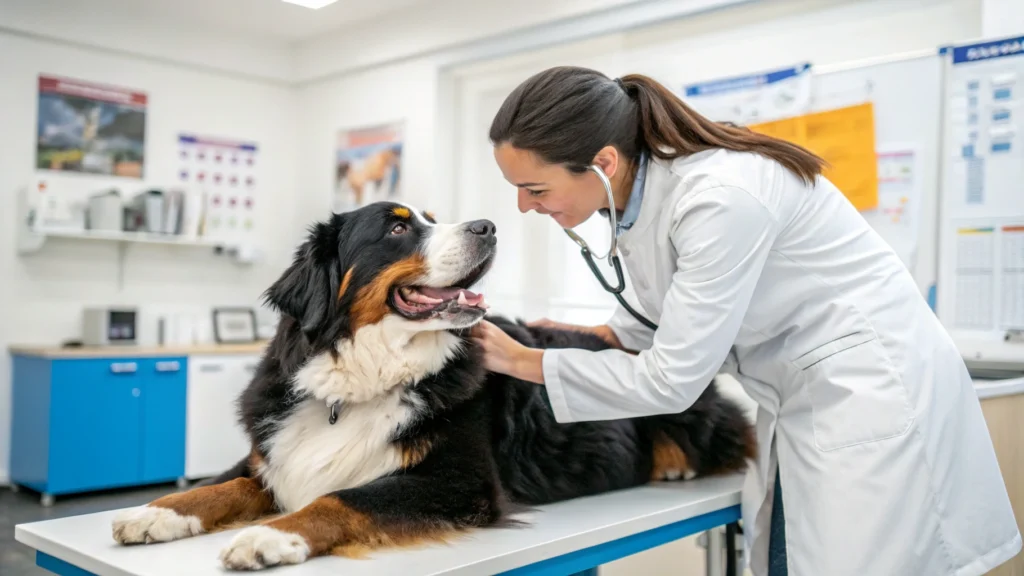
[IMAGE: Senior Bernese Mountain Dog at a veterinary checkup. Alt text: “Senior Bernese Mountain Dog being examined by a veterinarian during a health screening”]
2. Hip Dysplasia
Bernese Mountain Dog hip dysplasia affects roughly 15-20% of the breed, according to OFA breed statistics. It’s one of the most common Bernese Mountain Dog health issues after cancer, and one of the most expensive to treat.
The hip joint forms incorrectly — the ball doesn’t sit properly in the socket — and grinds down over time, causing arthritis and increasing pain with every year.
What owners typically notice first:
- “Bunny hopping” — both back legs moving together instead of alternating
- Struggling to stand up after lying down, especially in the morning
- Avoiding stairs or refusing to jump into the car
- A swaying, unsteady walk
- Losing muscle mass in the hind legs
Treatment ranges from daily management to major surgery:
- Conservative management (most mild-moderate cases): Weight control, anti-inflammatory meds like Rimadyl, joint supplements, physical therapy. About $500-1,000/year.
- Total Hip Replacement: The gold standard surgery. $3,000-7,000 per hip.
- Femoral Head Ostectomy (FHO): Removing the ball portion of the joint. $1,200-2,500 per hip. Less ideal for giant breeds but more affordable.
The single most important prevention step: Buy from a breeder who OFA-certifies both parents’ hips with ratings of “Good” or “Excellent.” No certificate, no purchase.
Beyond genetics: keep your Bernese lean (extra weight accelerates joint damage faster than anything), avoid hard-surface running before 18 months (growth plates aren’t closed yet), and start joint supplements early.
📌 Disclosure: Some product links below are affiliate links. I earn a small commission if you buy through them at no extra cost to you. This doesn’t influence my recommendations.
Recommended joint supplements:
- [Nutramax Cosequin DS Plus with MSM](affiliate link) — Glucosamine + chondroitin + MSM. One of the most widely recommended joint supplements in veterinary practice.
- [Dasuquin with MSM](affiliate link) — Veterinary-strength formula, slightly more potent.
3. Elbow Dysplasia
Elbow dysplasia affects 10-15% of Bernese and often shows up alongside hip dysplasia — a cruel double hit that significantly increases Bernese Mountain Dog vet costs over their lifetime. The elbow joint develops abnormally during that rapid giant-breed growth phase.
Signs to watch for: Front leg limping that’s usually worse after rest, holding the elbow away from the body, stiffness after exercise, and swelling around the joint.
Treatment mirrors the hip dysplasia approach — conservative management for mild cases, or arthroscopic surgery to remove bone fragments for severe cases ($2,000-4,000). Either way, most dogs need lifelong management.
Prevention: Same rules apply. OFA elbow certifications for both parents (rated “Normal”), weight control, and protecting those growing joints during puppyhood by limiting high-impact activity.
4. Bloat (Gastric Dilatation-Volvulus) — The Emergency That Gives No Warning 🚨
Bernese Mountain Dog bloat is the health issue that scares me most even as a cat owner. It kills fast, gives almost no advance warning, and about 10-15% of Bernese will experience it during their lifetime.
Here’s what happens: The stomach fills with gas and expands. Then it twists on itself, cutting off blood supply to the stomach and surrounding organs. The dog goes into shock. Without surgery, death can follow within hours.
The warning signs — memorize these even if you skip the rest of this article:
- Stomach looks bloated, feels hard and tight
- Trying to vomit but nothing comes up — this is THE classic sign
- Excessive drooling
- Restless and pacing, can’t settle down
- Rapid heartbeat
- Pale gums, weakness, collapse
If you see these signs together, you have 1-2 hours. Maybe less. Don’t wait to see if it improves. Go to the emergency vet.
Treatment survival rate within 2 hours: 80-90%. With delayed treatment: 50%.
Emergency surgery involves decompressing the stomach, untwisting it, and tacking it to the body wall (gastropexy) to prevent it from twisting again. Cost: $2,000-5,000.
How to reduce the risk of Bernese Mountain Dog bloat:
- Feed 2-3 smaller meals instead of one large meal
- Use a slow feeder bowl — gulping air is a major risk factor
- No exercise for 1 hour before and 2 hours after eating
- Ask your vet about prophylactic gastropexy during spay/neuter surgery ($800-1,500). This preventive stomach-tacking procedure is now recommended by many vets for all deep-chested breeds.
Without gastropexy, the recurrence rate after a bloat episode is 70-80%. That statistic alone makes the preventive surgery worth serious consideration for any Bernese owner.
[IMAGE: Simple Canva infographic showing bloat warning signs. Alt text: “Infographic showing warning signs of bloat in dogs including distended abdomen and unproductive retching”]
5. Progressive Retinal Atrophy (PRA)
PRA is an inherited eye disease that gradually destroys vision, eventually causing total blindness. It’s one of the Bernese Mountain Dog genetic diseases that affects 5-10% of the breed, typically showing up between ages 3-5.
The first signs are subtle: your dog starts bumping into furniture in dim light, hesitates at stairs when it’s dark, or seems unusually cautious outside at night. Pupils may look permanently dilated.
There is no treatment. Once PRA starts, vision loss progresses to complete blindness.
But here’s what surprised me during my research: Most dogs adjust remarkably well. Their sense of smell and hearing compensate, and with consistent furniture placement and baby gates at stairs, blind dogs live completely normal lives. Multiple Bernese owners in breed forums described their PRA-affected dogs still playing, still enjoying walks, and still seeming perfectly content. Dogs don’t feel sorry for themselves about blindness — they just adapt.
The genuinely good news: PRA is 100% preventable through genetic testing. A simple DNA test identifies carriers before breeding. Responsible breeders test every dog and never pair two carriers together.
If you’re buying a Bernese puppy, demand proof of PRA testing. [Embark Veterinary DNA Test](affiliate link) screens for PRA along with 200+ other genetic conditions for about $159.
6. Heart Disease (Dilated Cardiomyopathy)
DCM affects 5-8% of Bernese. The heart muscle weakens and stretches, reducing its ability to pump blood efficiently. Left untreated, it progresses to congestive heart failure.
Watch for: Coughing (especially at night or lying down), breathing faster than normal, getting tired on walks that used to be easy, fainting episodes, loss of appetite, or fluid buildup making the belly look swollen.
Diagnosis requires an echocardiogram ($300-500), X-rays, and ECG. Treatment involves lifelong medications — usually Pimobendan, ACE inhibitors, and diuretics — running $100-300/month. These ongoing costs add significantly to Bernese Mountain Dog vet costs over the years.
One important note about diet: The FDA issued a formal warning investigating a potential connection between grain-free diets and DCM in certain breeds. The science is still developing, but enough veterinary cardiologists have raised concerns that it’s worth paying attention to. Many now recommend grain-inclusive diets from established brands and adding taurine supplementation (500-1,000mg daily) as a precaution.
7. Von Willebrand’s Disease (vWD)
vWD is a bleeding disorder — similar to hemophilia in humans — affecting 3-5% of Bernese. A missing protein means blood doesn’t clot properly, making even minor injuries potentially dangerous.
Signs: Cuts that won’t stop bleeding, nosebleeds, bleeding gums, blood in urine or stool, and most dangerously, excessive bleeding during surgery.
How to manage it:
- Tell your vet about the diagnosis before ANY surgical procedure — non-negotiable
- Avoid aspirin and NSAIDs (they make bleeding worse)
- Desmopressin (DDAVP) can be given before planned procedures to temporarily boost clotting
- Keep styptic powder at home for minor cuts
Like PRA, vWD is completely preventable through genetic testing before breeding. Yet another reason your breeder choice matters more than almost anything else when it comes to Bernese Mountain Dog health issues.
Bernese Mountain Dog Lifespan: The Harsh Reality
Average Bernese Mountain Dog lifespan: 6-8 years.
For perspective, most dogs of similar size live 10-13 years. Golden Retrievers average 10-12. Labradors average 10-12. Even Great Danes, another giant breed, average 7-10.
A study published in the Journal of Veterinary Internal Medicine found the median Bernese Mountain Dog life expectancy was approximately 7 years, with cancer as the primary driver of early death.
I read through dozens of Bernese owner posts while researching this article, and the same feeling came up over and over — something along the lines of: “I knew the lifespan was short going in. I still wasn’t prepared.” Seven years sounds like an abstract number until it’s your dog reaching year six and you realize the math is not in your favor.
Can You Actually Extend a Bernese Mountain Dog’s Lifespan?
You can’t rewrite their DNA. But you can genuinely shift the odds.
Weight management is the single biggest factor you control. Studies on large breeds consistently show that lean dogs live longer — up to 2 years longer in some research. Your Bernese should be lean enough that you can easily feel their ribs. Males should weigh 80-120 lbs, not 130+. Females 70-100 lbs, not 110+.
If your Bernese is overweight right now, that’s actually good news in a strange way — it means there’s a lifespan improvement sitting right there waiting for you to grab it.
Cancer screening starting at age 5. Annual chest X-rays ($150-250) won’t prevent cancer, but they can catch treatable tumors before they become untreatable.
Quality nutrition. Stick with large-breed formulas from established brands. Given the DCM concerns, many vets now recommend grain-inclusive options like Hill’s Science Diet Large Breed, Purina Pro Plan Large Breed, or Royal Canin Giant Breed.
Joint supplements from early on. Starting glucosamine and chondroitin at 6-12 months protects joints before damage begins, not after.
Your breeder choice. Some Bernese bloodlines consistently produce dogs living 9-12 years. Others consistently lose dogs at 5-6. Ask the breeder directly: “What’s the average lifespan in your lines?” and “What have dogs in this pedigree died from?” If they dodge the question, walk away.
The Berner-Garde Foundation maintains longevity data that serious breeders reference when planning litters. If your breeder knows this database, that’s a very good sign.
Prevention Strategies That Actually Work Against Bernese Mountain Dog Health Issues
Choosing a Healthy Puppy — The Decision That Matters Most
So are Bernese Mountain Dogs healthy? Not naturally, no. But choosing the right breeder dramatically changes your individual dog’s odds. Every health certification below exists for a reason, and responsible breeders test for all of them.
Health tests both parents MUST have:
| Test | What It Screens | What You Want to See |
|---|---|---|
| OFA Hip Certification | Hip dysplasia | “Good” or “Excellent” |
| OFA Elbow Certification | Elbow dysplasia | “Normal” |
| Eye Exam (CAER) | PRA and other eye diseases | Clear annual certification |
| Cardiac Exam | Heart disease | Normal echocardiogram |
| vWD DNA Test | Bleeding disorder | Both “Clear” or max one “Carrier” |
| PRA DNA Test | Progressive blindness | Both “Clear” or max one “Carrier” |
These tests cost breeders $500-1,000 per dog. Their willingness to show documentation tells you exactly where their priorities are. You can verify any breeder’s OFA results yourself at ofa.org — look up the parents’ registered names.
Walk away immediately if you hear:
- “My dogs are healthy, I don’t need to test them” — Testing isn’t about what they look like. It’s about what they carry genetically.
- Can’t produce OFA certificates for both parents
- Has multiple litters available right now with no waiting list
- Price is below $2,000 — Quality Bernese from health-tested lines cost $2,500-4,000. Cheap puppies are cheap for a reason.
- Won’t let you contact owners from previous litters
Exercise: The Right Amount at the Right Age
Getting exercise wrong during puppyhood can set the stage for Bernese Mountain Dog health problems that last a lifetime.
Puppies (under 18 months): Growth plates aren’t closed yet. High-impact exercise now means joint problems later.
- ✅ Short walks: 5 minutes per month of age, twice daily (3-month-old puppy = 15-minute walks)
- ✅ Swimming — excellent low-impact exercise at any age
- ✅ Gentle play on grass with other dogs
- ❌ No jogging on pavement
- ❌ No repetitive ball-fetching or jumping
- ❌ No hikes longer than 30 minutes
Adults (18 months to 7 years):
- ✅ 30-60 minutes of moderate daily exercise
- ✅ Walking, trail hiking, swimming
- ❌ Limit hard-surface running
Seniors (7+ years):
- Gentle walks, 20-30 minutes
- Swimming is excellent for arthritic joints
- Let them set the pace — they know their limits better than any guideline
Supplement Schedule for Bernese
Starting supplements before problems appear is one of the few evidence-backed strategies for reducing Bernese Mountain Dog health issues related to joints and inflammation.
📌 Disclosure: Product links below are affiliate links. I earn a small commission if you buy through them at no extra cost to you.
Joint support (start at 6-12 months of age):
- Glucosamine + Chondroitin: 1,500-2,000mg daily
- MSM: 500-1,000mg daily
- [Nutramax Cosequin DS Plus with MSM](affiliate link) — $35-45/month
- [Dasuquin with MSM](affiliate link) — $40-55/month
Heart health:
- Taurine: 500-1,000mg daily
- Omega-3 fatty acids: 2,000-4,000mg EPA/DHA daily
- [Nordic Naturals Omega-3 Pet](affiliate link)
Estimated monthly supplement cost: $70-150. Compare that to a $7,000 hip replacement and it’s the best investment you’ll make.
Why Pet Insurance for Bernese Mountain Dog Owners Isn’t Optional
After spending days researching Bernese Mountain Dog vet costs, this is the section I’d read twice if I were considering this breed.
Here are the cold numbers:
- 50% of Bernese will face at least one health crisis costing $5,000 or more
- Cancer treatment: $5,000-15,000
- Hip replacement (both hips): $6,000-14,000
- Emergency bloat surgery: $2,000-5,000
Without insurance, owners face a choice nobody should have to make: go into serious debt or euthanize a dog that could have been saved with treatment that exists and works.
Pet insurance for Bernese Mountain Dog owners converts one devastating surprise bill into a monthly payment you can budget for.
What your policy absolutely MUST cover:
- ✅ Hereditary and genetic conditions — non-negotiable for this breed
- ✅ Cancer with high or unlimited payout limits
- ✅ Orthopedic coverage (hip and elbow surgery)
- ✅ Emergency care including bloat
- ✅ Annual limits of at least $15,000, ideally unlimited
- ❌ Reject any policy excluding breed-specific conditions
Timing is critical. Enroll before age 3. Once a condition is diagnosed, it becomes pre-existing and will never be covered by any insurer. A dog diagnosed with hip dysplasia at age 2 cannot get hip coverage at age 3. Ever.
📌 Disclosure: Insurance links below are affiliate links.
Providers worth comparing for Bernese:
| Provider | Key Benefit | Estimated Monthly Cost |
|---|---|---|
| Trupanion | Unlimited lifetime coverage, 90% reimbursement | $120-150/month |
| Healthy Paws | Unlimited annual coverage, fast claims | $110-140/month |
| Embrace | Diminishing deductible rewards healthy years | $100-130/month |
The math that should make this decision easy:
- Total premiums over 7 years: $8,400-12,600
- One cancer diagnosis: $8,000-15,000
- One hip replacement: $6,000-14,000
Pet insurance for Bernese Mountain Dog owners pays for itself with a single major claim. For a breed where major claims are more likely than not, the question isn’t whether you can afford insurance — it’s whether you can afford not having it.
Based on my research, Trupanion’s unlimited lifetime benefit stands out most for Bernese specifically. With this breed, you’re not planning for one incident. You might face cancer AND dysplasia AND heart disease in the same dog over the span of a few years.
Vet Visit Schedule: Managing Bernese Mountain Dog Health Issues by Age
This screening schedule is Bernese-specific. Save it on your phone or print it out.
Ages 1-4: Building the Baseline
| What | How Often | Estimated Cost |
|---|---|---|
| Comprehensive physical exam | Once a year | $50-100 |
| Comprehensive blood work | Once a year | $100-200 |
| OFA hip and elbow X-rays | Once at age 2 | $200-400 |
| Eye exam (CAER screening) | Once at age 2 | $50-100 |
| Heartworm and flea/tick prevention | Monthly | $200-400/year |
| Estimated annual total | $300-500 |
Ages 5-7: Cancer Watch Begins
This is when screening ramps up. Bernese Mountain Dog cancer risk increases sharply after age 5.
| What | How Often | Estimated Cost |
|---|---|---|
| Comprehensive physical exam | Every 6 months | $100-200 |
| Comprehensive blood work | Once a year | $100-200 |
| Chest X-rays (cancer screening) | Once a year | $150-250 |
| Cardiac screening (echocardiogram) | Once | $300-500 |
| Estimated annual total | $800-1,200 |
Ages 8+: Senior Monitoring
If your Bernese reaches 8, you’re beating the average Bernese Mountain Dog lifespan. Keep the monitoring close.
| What | How Often | Estimated Cost |
|---|---|---|
| Comprehensive physical exam | Every 6 months | $100-200 |
| Blood work | Every 6 months | $200-400 |
| Chest X-rays | Every 6 months | $300-500 |
| Estimated annual total | $1,200-2,000 |
When to See a Veterinarian
🚨 EMERGENCY — Drive to the ER Right Now
- Distended abdomen + unproductive retching (bloat)
- Difficulty breathing, pale or blue gums
- Collapse or inability to stand
- Seizures
- Uncontrollable bleeding
⚠️ See Your Vet Within 24 Hours
- Sudden limping or new lameness
- Won’t eat for 24+ hours
- Repeated vomiting or diarrhea — our guide on home remedies for dog diarrhea covers immediate steps while you arrange an appointment
- Persistent coughing
- Won’t get up for walks or food
- Drinking significantly more water than normal
📋 Schedule a Regular Appointment
- Gradual weight changes in either direction
- Skin problems or constant scratching
- Mild, on-and-off limping
- Behavioral changes
- Ear infections (head shaking, bad smell)
Frequently Asked Questions About Bernese Mountain Dog Health Issues
What is the biggest health problem in Bernese Mountain Dogs?
Cancer — specifically histiocytic sarcoma. It affects an estimated 25-50% of the breed, making it the leading cause of death by a wide margin. It typically appears between ages 6-8 and progresses aggressively, with average survival of only 3-6 months even with chemotherapy costing $5,000-15,000. There’s currently no genetic test to predict it, making annual chest X-rays after age 5 the only proactive screening tool available.
How long do Bernese Mountain Dogs typically live?
The average Bernese Mountain Dog lifespan is 6-8 years, with a median around 7 years. That’s roughly half the lifespan of other breeds their size. Cancer is the primary reason for this shortened Bernese Mountain Dog life expectancy. However, some Bernese from carefully selected, health-tested bloodlines reach 10-12 years. Weight management, cancer screening after age 5, joint supplements, and choosing a longevity-focused breeder all contribute to better odds.
Are Bernese Mountain Dogs worth getting despite the health risks?
Every Bernese owner I encountered during my research said the same thing: absolutely yes, but go in prepared. You need to budget $2,000-4,000/year in routine care plus insurance, with the possibility of $10,000+ for a major health crisis. You need to be emotionally ready to potentially say goodbye at 6-8 years. If you can handle both of those realities, Bernese owners will tell you there’s no more loving, loyal, or gentle breed out there.
How much do Bernese Mountain Dog vet costs add up to?
For a healthy Bernese: $1,500-3,000/year covering exams, bloodwork, preventive care, and supplements. Over a 7-year lifespan, that’s $15,000-25,000 in baseline Bernese Mountain Dog vet costs. Major health events add $5,000-15,000 each on top of that. Pet insurance at $100-150/month is the most reliable way to protect against costs that could push total lifetime spending past $40,000.
Are Bernese Mountain Dogs healthy compared to other breeds?
Honestly, no. When people ask are Bernese Mountain Dogs healthy, the truthful answer is that they’re one of the least healthy purebred breeds in terms of genetic disease prevalence and lifespan. They face higher cancer rates, more orthopedic issues, and shorter lifespans than most breeds their size. That said, a Bernese from health-tested parents with a committed owner who follows prevention strategies can still live a happy, comfortable life. The breed isn’t doomed — it just requires more awareness, more screening, and more financial preparation than most.
Can Bernese Mountain Dog health issues be prevented?
Some can, some can’t. PRA and Von Willebrand’s disease are 100% preventable through genetic testing before breeding. Bernese Mountain Dog hip dysplasia risk drops significantly with OFA-certified parents, weight management, and proper exercise during growth. Bernese Mountain Dog bloat risk decreases with proper feeding habits and prophylactic gastropexy. But histiocytic sarcoma — the most devastating of all Bernese Mountain Dog health problems — currently has no genetic test and no proven prevention. Early detection through screening is the best tool available.
Is pet insurance worth it for a Bernese Mountain Dog?
Without any hesitation, yes. Pet insurance for Bernese Mountain Dog owners is closer to a necessity than a choice. Half of all Bernese face a health crisis exceeding $5,000. Enroll before age 3, choose a plan covering hereditary conditions and cancer with high or unlimited limits, and plan for $100-150/month. One major claim will likely exceed every premium dollar you’ve paid over your dog’s entire life.
Bottom Line
Researching Bernese Mountain Dog health issues changed how I think about breed-specific health. I’m a cat person — my four cats have their own quirks and health considerations, but nothing on the scale of what Bernese owners face. The people who choose this breed commit knowing they’ll likely have fewer years than they want and higher vet bills than they expect. And they do it anyway, because the breed is genuinely that special.
If you take only five things away from this guide:
- Your breeder choice determines more than anything else. Health-tested parents from longevity-tracked lines are worth every dollar of that $2,500-4,000 price tag.
- Get pet insurance before age 3. By the time you need it, it’s too late to buy it.
- Keep them lean. It’s free, it’s proven, and it can add years to their life.
- Start screening at age 5. Annual chest X-rays catch problems when options still exist.
- Protect those joints from the start. Supplements at 6 months, controlled exercise until 18 months, lean weight for life.
You can’t guarantee a long life with any dog, and certainly not with a Bernese. But you can guarantee that every year they get is as healthy and comfortable as possible.
Hug your Bernese tonight. Every single day with them counts.
This article is for educational purposes only and does not replace professional veterinary advice. Always consult a licensed veterinarian about your dog’s health. If your Bernese shows signs of bloat or any other emergency, seek immediate veterinary care — don’t rely on any online resource, including this one.
Related articles you might find helpful:
- How to Stop Dog Shedding: 7 Proven Home Remedies — Bernese shed heavily year-round. This guide covers what actually works.
- Home Remedies for Dog Diarrhea: 7 Proven Solutions — Digestive issues are common in large breeds. Know what to do before the vet appointment.
- Why Does My Dog Bark in His Sleep? — Understanding your dog’s sleep behavior and when it signals a health concern.