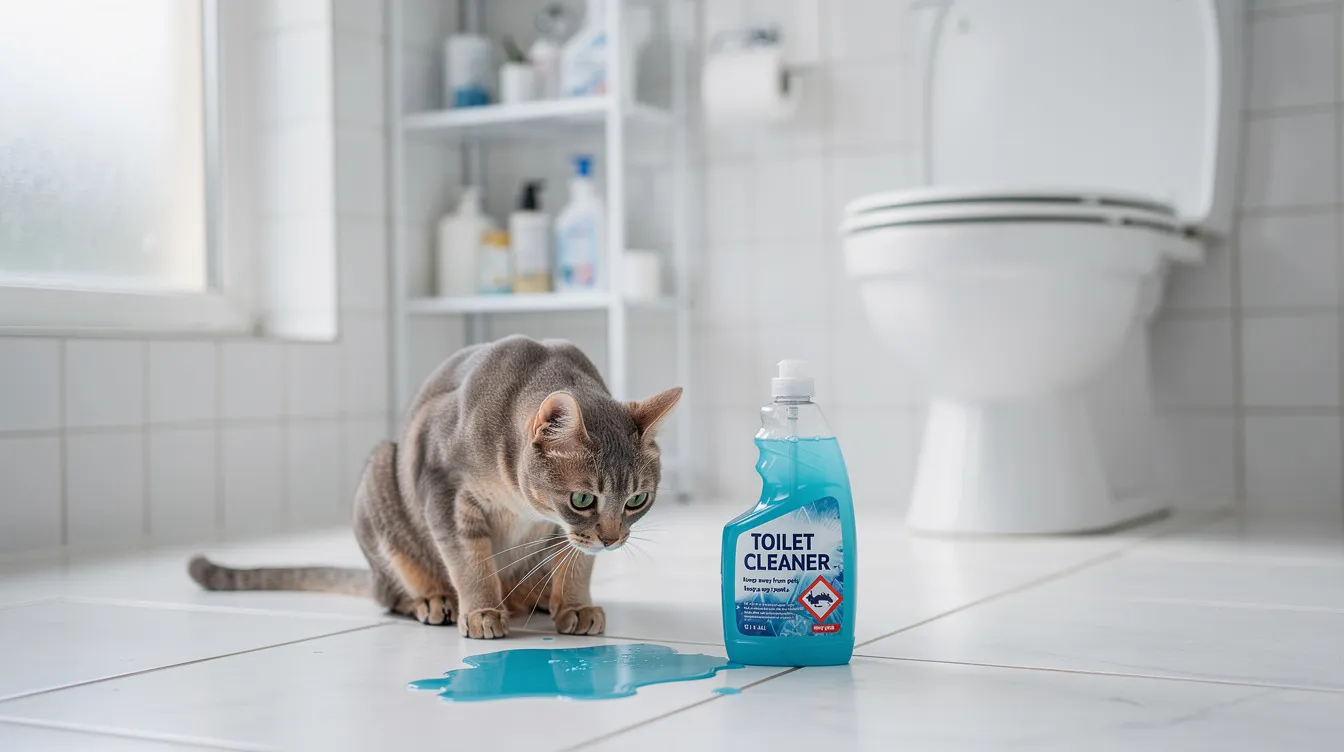
- Drooling, vomiting, or pawing at the mouth — rinse mouth with water, go to vet
- Breathing difficulty, wheezing, or coughing — emergency vet immediately
- Seizures, collapse, or unresponsiveness — emergency vet immediately
- Burns or redness on tongue or gums — vet within the hour
ASPCA Animal Poison Control: (888) 426-4435 — 24/7. Bring the cleaner bottle.
If it was dried or diluted residue and your cat has no symptoms after 2–4 hours, they’ll likely be fine.
Rinse the mouth with water, identify the exact product, and monitor closely. If any symptoms appear — drooling, vomiting, mouth burns, lethargy — see the vet immediately. Concentrated or undiluted cleaner: go now, do not wait.
My cat licked toilet cleaner — here’s the most important thing to know: a tiny lick of dried residue is very different from drinking concentrated cleaner.
Most cats that lick a small amount of diluted residue show no symptoms at all. But you need to know what to watch for and exactly when to act.
I’ve been through this twice. Once my cat was near the toilet rim right after cleaning — I called the vet, monitored for four hours, and she was completely fine.
The second time, another cat walked through a freshly cleaned bathroom floor and immediately started licking her paws in the hallway.
My vet explained that even residue on paws causes oral irritation because cats groom constantly. Since then, I keep all cats out until every surface is bone dry.
7 Steps to Take Immediately
- Stay calm — most small exposures are not emergencies.
- Remove your cat — prevent any further contact with the product or surface.
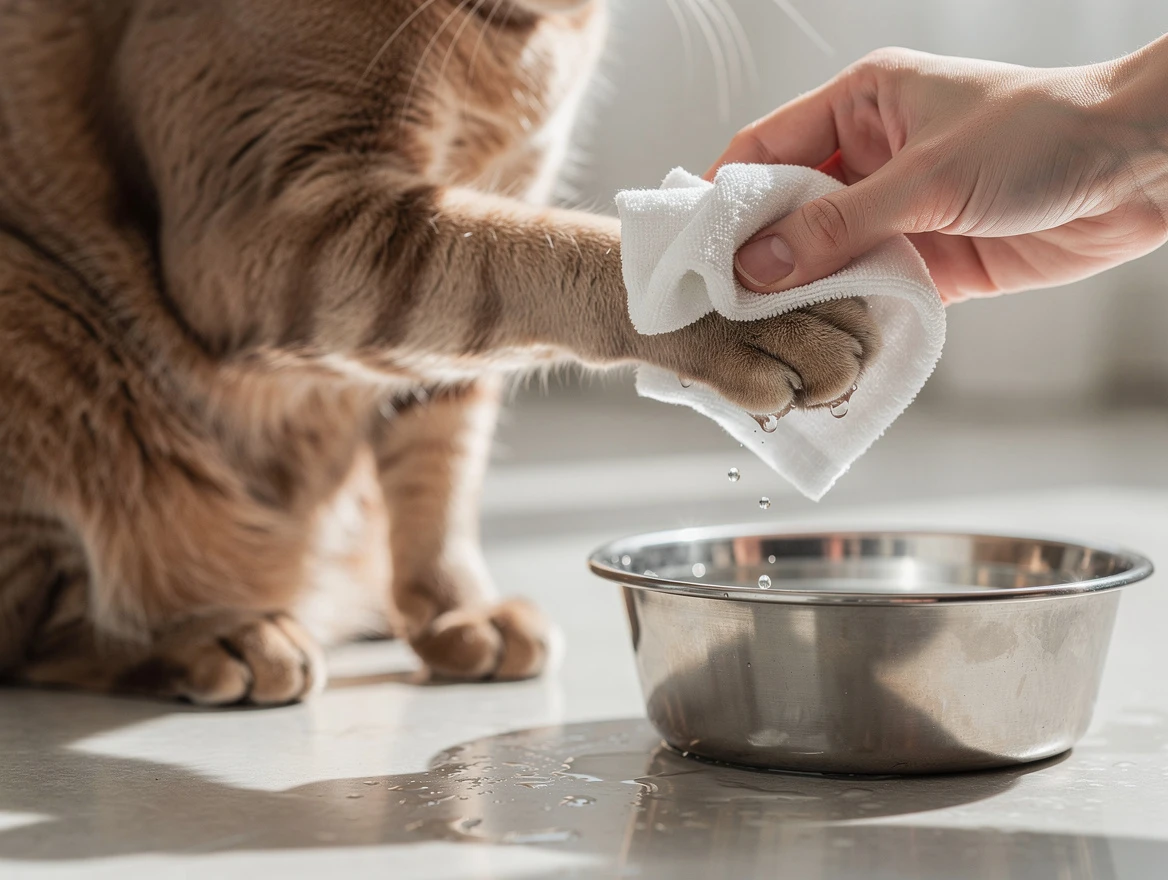
- Wipe paws with a damp cloth — residue on paws means ongoing exposure every time they groom.
- Check the mouth — look for redness, burns, or raw areas on the tongue, gums, and lips.
- Rinse the mouth gently — cool water via syringe or wet cloth if your cat allows it. Do NOT force water — aspiration risk.
- Identify the exact product — read the full ingredient list on the bottle. This is what your vet needs most.
- Call your vet or Poison Control — (888) 426-4435. They assess risk based on the specific product and exposure.
What Ingredients in Toilet Cleaner Are Toxic to Cats
Not all cleaning products are equally toxic to cats. What matters most is the specific ingredient and concentration.
| Ingredient | Found In | Danger for Cats | Action |
|---|---|---|---|
| Phenols / Pine oil | Disinfectants and cleaners with a strong pine scent | 🔴 Very High — cats cannot metabolize phenols, liver failure risk | Emergency vet immediately |
| Hydrochloric acid | Acid-based gel bowl cleaners | 🔴 High — severe chemical burns | Vet same day |
| Bleach (sodium hypochlorite) | Household bleach-based cleaners | 🟠 Moderate — corrosive, oral/esophageal irritation | Rinse mouth, call vet |
| Quaternary ammonium | Some disinfectant sprays | 🟠 Moderate — oral ulceration, drooling | Call vet, monitor |
| Ammonia | Some multi-surface cleaners | 🟡 Moderate — irritant, fume risk | Fresh air, rinse, monitor |
| Blue dye tablet (diluted) | In-tank toilet tablets | 🟢 Low — very diluted | Monitor, keep lid closed |
The most critical fact: cats lack the liver enzyme (glucuronyl transferase) needed to break down phenols efficiently.
Pine oil-based cleaners are a same-day emergency even if your cat licked a small amount and appears completely fine. Check the label — many current disinfectants have reformulated away from pine oil over the years, so confirm the actual ingredients rather than assuming based on scent or brand.
Also never mix bleach and ammonia — the combination creates chloramine gas that is toxic to cats even through inhalation alone.
Can Toilet Cleaner Kill a Cat
Yes, in serious cases it can. The risk depends entirely on the product and how much was consumed.
A small lick of dried bleach residue is unlikely to be fatal — most cats recover completely without treatment. Phenol-based cleaners and concentrated acid-based products are a very different story.
Phenol-based cleaners are the most dangerous. Cats cannot metabolize them well, and liver failure can develop 12–72 hours after exposure, sometimes with no early symptoms at all.
Any pine oil exposure needs a vet visit even if your cat seems perfectly fine right now.
Concentrated hydrochloric acid causes immediate chemical burns to the mouth, throat, and stomach. A significant lick can cause shock. This is a minutes-matter emergency, not a watch-and-wait situation.
✅ Emergency vs Same-Day vs Monitor
- Emergency now: Phenol/pine oil exposure, acid-based cleaner, seizures, collapse, breathing difficulty
- Same day vet: Concentrated bleach lick, any symptoms appearing, unsure of product
- Call and monitor: Tiny dried residue lick, blue toilet water, zero symptoms after 2 hours
Symptoms of Toilet Cleaner Poisoning in Cats
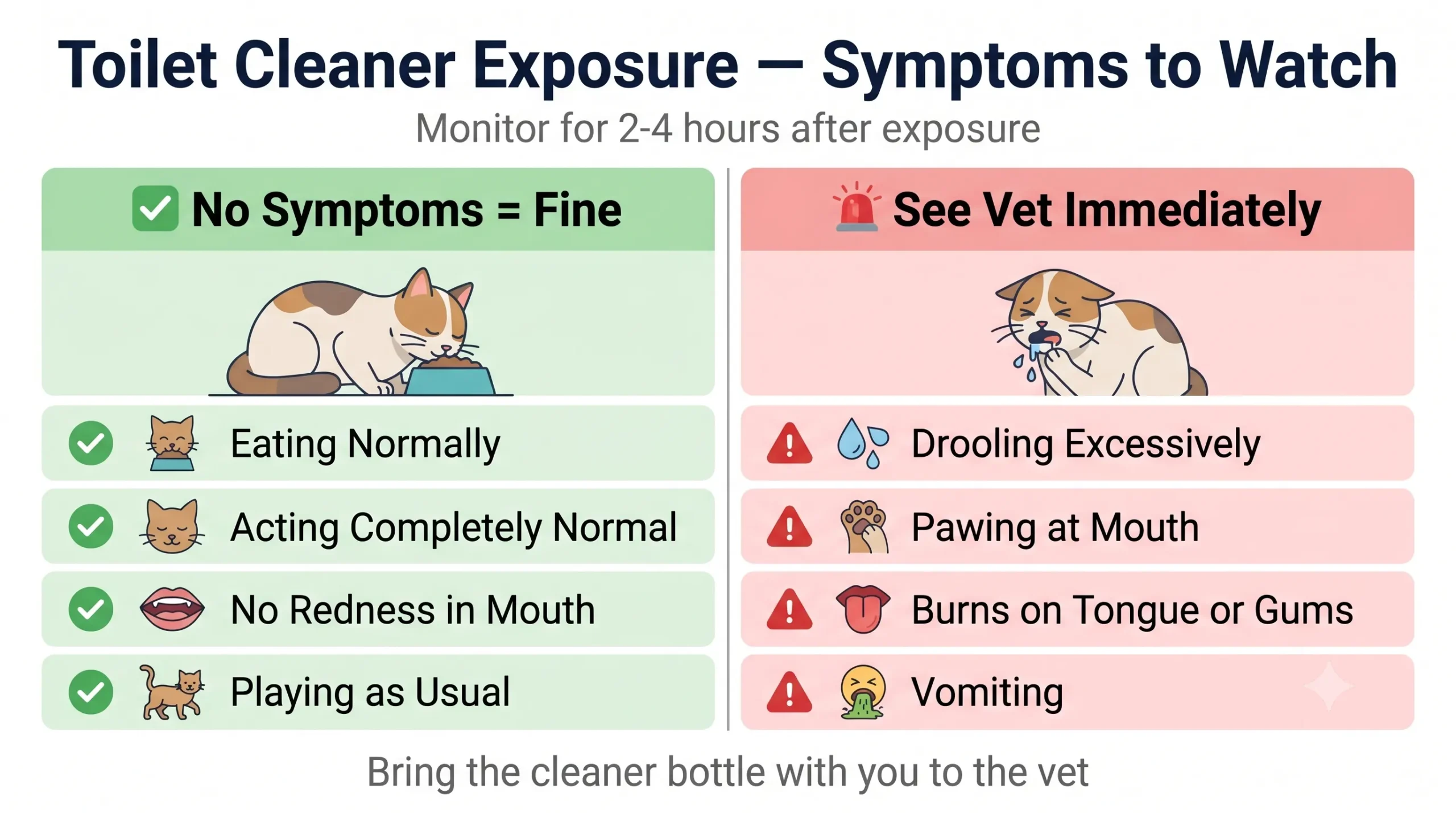
Watch for these in the first 2–4 hours after exposure:
- Drooling or excessive salivation — first sign of oral irritation
- Pawing at the mouth — pain or burning in the mouth or throat
- Vomiting — body trying to expel the irritant. Related: Cat Vomiting White Foam
- Loss of appetite — mouth or throat pain makes eating uncomfortable. Related: My Cat Is Not Eating or Drinking and Very Weak
- Red, raw, or white patches on tongue or gums — chemical burns
- Lethargy or hiding — cats in pain withdraw. Related: My Cat Is Lethargic But Eating and Drinking
- Difficulty breathing or wheezing — fumes or liquid reached the airway
- Won’t drink water — throat pain or nausea
No symptoms after 4 hours? For bleach-based and diluted exposures, your cat is almost certainly fine. Continue casual monitoring for 24 hours total.
How Long After Licking Toilet Cleaner Do Symptoms Appear
| Time After Exposure | Possible Symptoms | Action |
|---|---|---|
| 0–30 minutes | Drooling, lip licking, pawing at mouth | Rinse mouth, call vet now |
| 30 min – 2 hours | Vomiting, mouth redness, early lethargy | Go to vet if any symptom present |
| 2–12 hours | Continued lethargy, appetite loss, hiding | Vet visit — do not delay |
| 12–72 hours | Phenol cases: jaundice, weakness, collapse | Emergency vet — liver damage risk |
| No symptoms after 4 hours | Likely fine for bleach/diluted exposure | Monitor for 24 hours, then relax |
Cat Drank Blue Toilet Water
If your cat drank blue toilet water from an in-tank tablet, this is the least concerning scenario. The chemical concentration is very low because the tablet dissolves slowly into a large water volume.
Most cats experience nothing more than mild stomach upset. However, if your cat drank water from a toilet recently cleaned with poured-in concentrated cleaner that wasn’t fully flushed, the concentration is much higher. That warrants an immediate vet call.
Keep the toilet lid closed as the permanent solution if your cat regularly seeks out the toilet for water.
Pet Safe Toilet Bowl Cleaner Alternatives
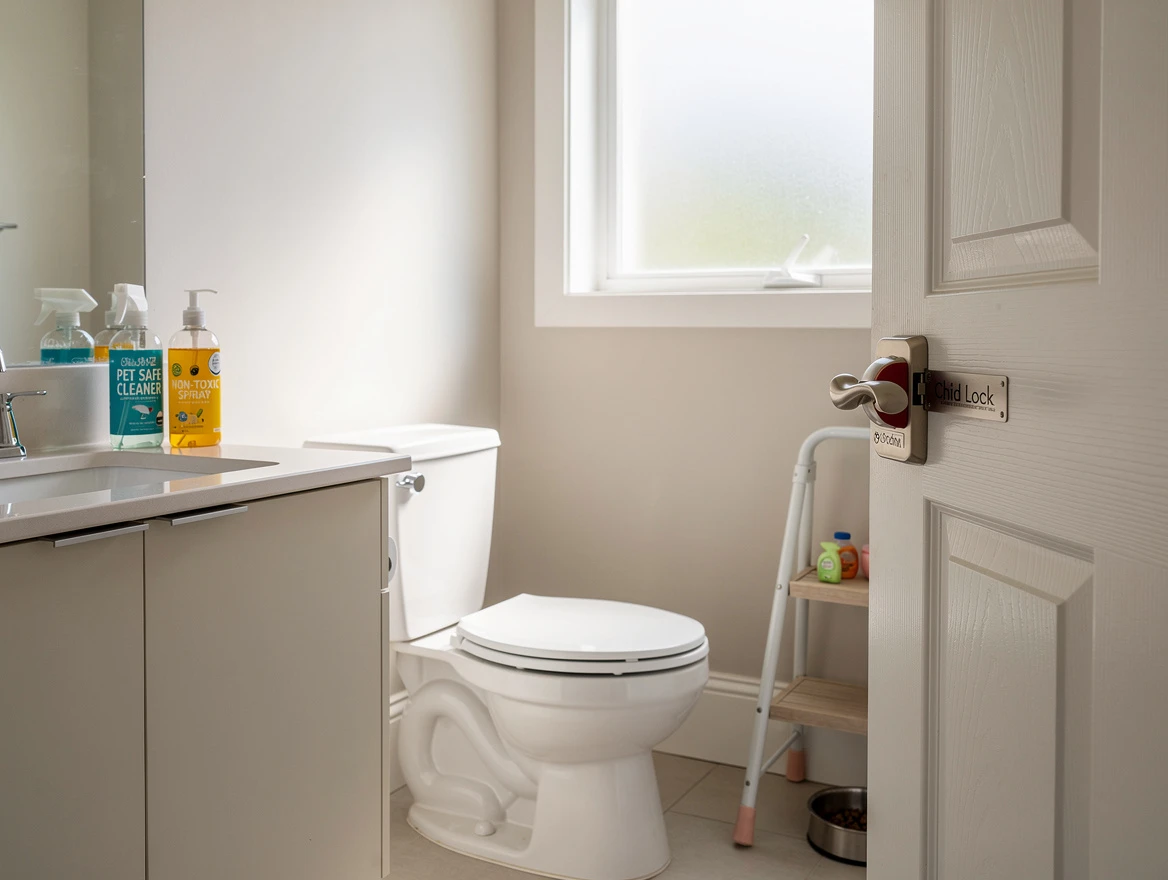
After my scares, I switched to cat-safe toilet bowl cleaner options entirely. The rule: avoid bleach, phenols, and strong acids.
- White vinegar + baking soda — safest option. Pour 1 cup vinegar, add baking soda, scrub after 15 minutes.
- Hydrogen peroxide (3%) — breaks down into water and oxygen. Keep your cat out of the bathroom until it’s fully dry — undiluted peroxide licked directly will cause vomiting.
- Enzyme-based cleaners — look for products specifically labeled “pet safe” on the packaging
- Castile soap — plant-based, non-toxic option for general cleaning
If you must use a standard cleaner: flush three times, wipe all surfaces, ventilate the room, and keep the door closed until bone dry.
Automatic toilet bowl cleaners are not safe for pets — they continuously release chemicals into water your cat may drink. A closed toilet lid is always more reliable than any “pet safe” claim on a chemical product.
Frequently Asked Questions
If it was a small amount of dried or diluted residue with no symptoms after 2–4 hours, she’ll almost certainly be fine.
If she licked concentrated cleaner or pine oil products, or if any symptoms appear — drooling, vomiting, burns, lethargy — see the vet immediately.
In serious cases, yes. Pine oil and phenol-based cleaners are the most dangerous — cats cannot metabolize phenols well and liver failure can develop hours later with no early warning signs.
Concentrated acid-based cleaners cause immediate severe burns. A small lick of dried bleach residue is unlikely to be fatal if caught early.
Phenol and quaternary ammonium-based disinfectants are both harmful to cats. Symptoms include drooling, vomiting, oral burns, breathing difficulty, lethargy, and in severe cases liver damage. Call your vet or ASPCA Poison Control (888-426-4435) immediately if exposure occurred — bring the bottle so they can check the exact ingredients.
The Bottom Line
My cat licked toilet cleaner — the outcome depends entirely on the product and how much was consumed.
Dried or diluted bleach residue: rinse, monitor for 4 hours, likely fine. Phenol or acid-based cleaner of any amount: emergency vet now, even with no symptoms. Always bring the product bottle.
Switch to pet-safe toilet bowl cleaner alternatives and keep the toilet lid closed permanently. Those two steps eliminate this risk entirely.
Related: Cat Vomiting White Foam and My Cat Ate a Lily and Nothing Happened — two other household toxin exposures with similar protocols.
Related Articles
When appetite loss after exposure becomes urgent.
Lethargy after chemical exposure needs monitoring.