The Day Sarah’s Cat Almost Didn’t Make It
I’ll never forget the look on Sarah’s face when she walked into my clinic with Mittens—a beautiful gray tabby who could barely jump onto the exam table. Sarah had been feeding her what she thought was right: one full can of wet food every morning, plus another can at night. “The can says it’s for adult cats, so I figured one can equaled one meal,” she told me, worry creasing her forehead.
Mittens was overweight. Not just a little chubby—clinically overweight in a way that was putting stress on her heart and joints. But here’s the thing: Sarah wasn’t being negligent. She genuinely didn’t know how much wet food to feed a cat. And honestly? That’s the most common question I get asked in my practice.
Today, I want to walk you through the exact approach we used to transform Mittens. Because whether your cat is already overweight or you’re just starting out, knowing how much wet food per day your specific cat needs might be the most important decision you make for their health.
Why “One Can Per Day” is Almost Always Wrong
Here’s what I’ve learned after 15 years of veterinary practice: the biggest mistake cat parents make is treating all wet food cans the same.
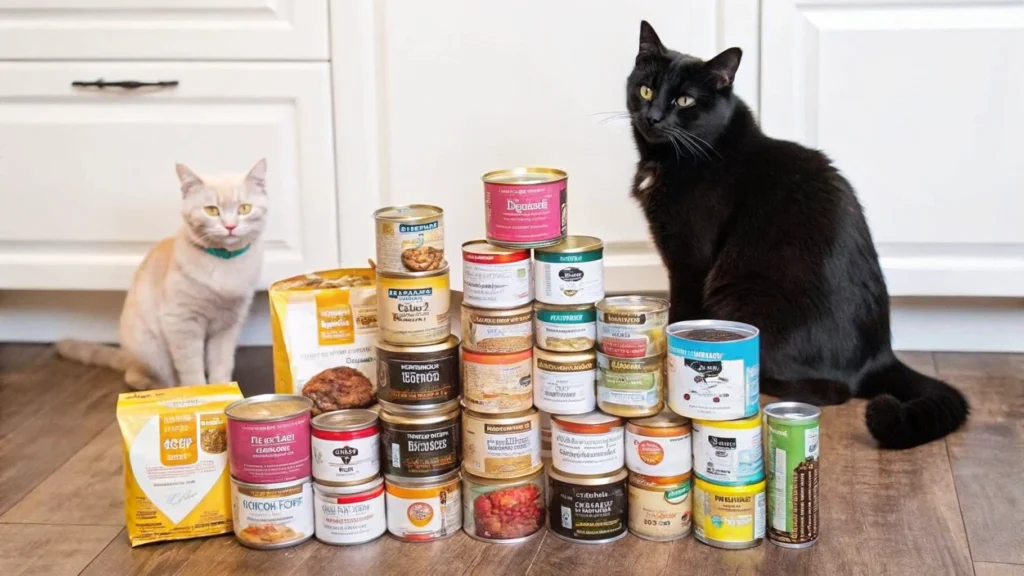
A 3-ounce pouch? A 5.5-ounce can? A 13-ounce family-size container? They’re not all the same caloric density, and they’re definitely not interchangeable. When I ask people “how much wet food do you feed your cat?”, most say something like “one can” without any idea what that actually means nutritionally.
The truth is, how much wet food should your cat eat depends on five specific factors that nobody—and I mean nobody—talks about:
- Your cat’s current weight (not what they should weigh)
- Their activity level (couch potato vs. hunting machine)
- Their age (kittens, adults, seniors all have different needs)
- Their health conditions (thyroid issues, diabetes, kidney disease change everything)
- The calorie content of the specific wet food you’re using
Most guides oversimplify this. They say “feed 1-2 cans daily” like your cat is generic. Your cat is not generic. They’re an individual with unique needs. Understanding how much wet cat food per day your specific cat truly needs is the foundation of proper feline nutrition—and it’s different for every single cat.
The Real Formula: How Much Wet Food Per Day Actually Works
Let me show you the exact approach I used with Mittens, and what I use with every cat that comes through my clinic. Understanding how much wet food to feed a cat is crucial, but so is knowing how much wet food should a cat eat based on individual factors.
Step 1: Calculate Your Cat’s Daily Calorie Needs
This is where most people get lost, but I promise it’s simpler than it sounds.
The Basic Formula:
(Your cat's current weight in pounds × 10) + 70 = Daily calorie needs
According to the American Veterinary Medical Association (AVMA), this formula provides a solid foundation for calculating your cat’s baseline caloric needs, though individual variations always apply.
Let’s use Mittens as an example. She weighed 16 pounds (overweight), so: (16 × 10) + 70 = 230 calories per day
Now, here’s the crucial part: this formula assumes average activity. If your cat is super active (which is rare—let’s be honest), you might add 10-15%. If your cat barely moves (more common), you might subtract 10-15%.
For Mittens, we actually reduced her target to about 190 calories daily while we worked on getting her weight down. This is important: when you’re helping a cat lose weight, you don’t crash-diet them. You create a gentle deficit over months, not weeks.
The question becomes: how much wet cat food per day should that be? That’s what Step 2 answers.
Step 2: Check Your Wet Food’s Calorie Content
Here’s where people get frustrated. The label on your can matters tremendously.
A typical 5.5-ounce can of premium wet food has about 150-200 calories. A budget brand might have 90-120. That’s a huge difference.
When Sarah checked Mittens’ food, she discovered each can had about 200 calories. She was feeding 400 calories daily—for a cat that needed about 180-200. No wonder Mittens kept gaining weight.
Step 3: Divide Into Two Meals
Never feed a cat their entire daily wet food in one sitting. I know it’s easier, but it’s not how cats naturally eat. In the wild, cats eat small meals throughout the day.
If Mittens needed 190 calories daily:
- Breakfast: 95 calories (roughly half a 5.5-oz can)
- Dinner: 95 calories (roughly half a 5.5-oz can)
This spread-out approach also keeps their metabolism active and helps with digestion.
The Transformation: What Changed for Mittens
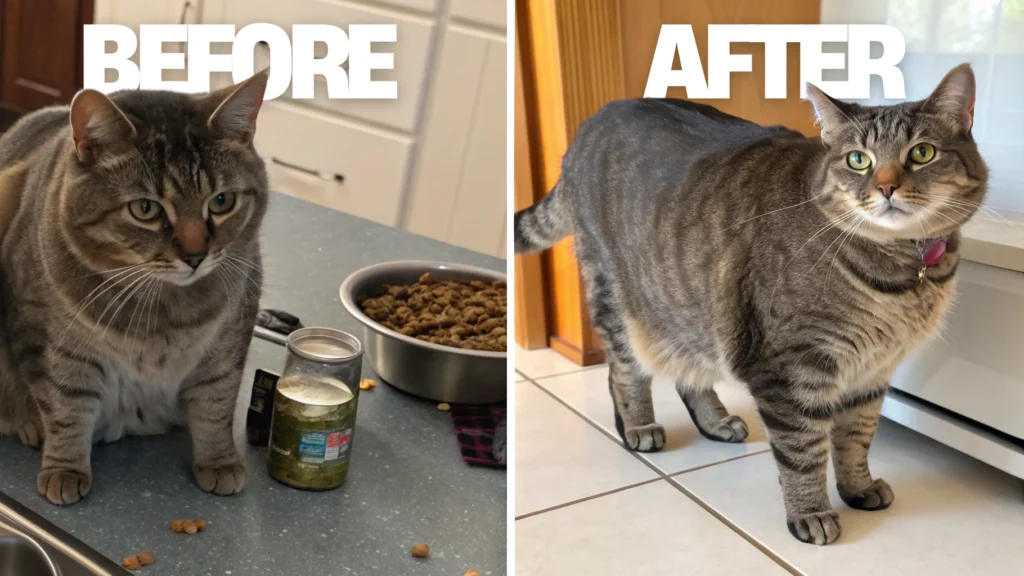
Within two weeks of switching to the right amount of wet food, Sarah noticed something amazing. Mittens was more playful. Within a month, she could jump higher. By month three, she was a different cat.
I’m not exaggerating when I say that getting how much wet food to feed a cat right literally added years to Mittens’ life.
Here’s what we saw:
Month 1: Mittens lost 0.5 pounds. Her energy increased noticeably.
Month 3: She’d lost 2 pounds. Sarah mentioned Mittens was sleeping less during the day and actually asking to play.
Month 6: Mittens had reached 12 pounds—a healthy weight for her frame. Her bloodwork was better. Her vet-assessed “pain score” went from 6/10 down to 1/10.
The best part? Sarah wasn’t hungry all the time or stressed about feeding. She finally understood how much wet food per day worked for her specific cat, using a formula instead of guessing.
Not All Cats Are the Same: Feeding Chart by Life Stage
This is where the feeding formula gets more nuanced. Your cat’s age dramatically changes what they need. Many people ask: is wet food better for cats than dry? That depends on your specific situation—but once you decide on wet, knowing the right amounts is critical.
Kittens (8 weeks to 1 year)
Kittens are basically tiny furry growth machines. They need nearly double the calories of adult cats per pound of body weight.
A 4-pound kitten needs roughly: (4 × 10) + 70 = 110 calories daily
But wait—kittens also need food more frequently. Divide this into 3-4 meals:
- That’s about 30 calories per meal
- Roughly 1/4 of a standard 5.5-oz can per meal (if that can has 120 calories)
When feeding kittens wet cat food for kittens specifically, you’ll notice it’s formulated differently—higher protein, more taurine. That’s intentional and important. Don’t switch to adult food until they’re at least 12 months old.
Many new kitten parents ask: is wet food better for cats starting young? In my experience, yes—it establishes healthy hydration habits early.
Adult Cats (1-7 years)
This is where most of our cats sit. Adults need that steady formula we talked about.
Average healthy adult (10 pounds): (10 × 10) + 70 = 170 calories daily
Divided into two meals = 85 calories per meal
That’s roughly half a standard can if you’re using premium wet food.
But here’s what I want you to understand: “average” is a range, not a target. A 10-pound active cat might need 190 calories. A 10-pound couch-sleeping cat might need 150. Watch your cat, not just the numbers.
Senior Cats (7+ years)
Senior cats are tricky. Their metabolism slows, but their protein needs actually go up to protect muscle mass. This is counterintuitive for most people.
A 10-pound senior cat still needs roughly: (10 × 10) + 70 = 170 calories daily
But the composition changes. You want higher protein, easier-to-digest ingredients, and potentially added joint support (glucosamine). A senior cat eating regular adult food might maintain weight but lose muscle—which is exactly what we don’t want.
When feeding senior cats specifically, I recommend slightly smaller portions of higher-quality senior wet cat food rather than larger portions of cheaper food. This is different from younger cats and worth the investment for their quality of life.
The Wet Food Portions by Weight Chart
Let me make this even easier. Here’s what feeding chart guidelines look like for different weights, assuming premium wet food (180 calories per 5.5 oz can). This shows how many cans of wet food for cat you’ll need daily, answering the question so many people ask: how much wet food should a cat eat based on their size?
| Cat Weight | Daily Calories | Daily Wet Food | Per Meal (2x) |
|---|---|---|---|
| 5 lbs | 120 | 0.35 cans | 1/3 can |
| 8 lbs | 150 | 0.42 cans | 1/4 can |
| 10 lbs | 170 | 0.47 cans | 1/2 can |
| 12 lbs | 190 | 0.53 cans | 1/2 can |
| 15 lbs | 220 | 0.61 cans | 0.3 cans |
| 18 lbs | 250 | 0.69 cans | 0.35 cans |
Important: If you’re using budget or budget-plus food (lower calories), these numbers change. A lower-calorie food might mean you feed slightly more volume but fewer actual calories—which can be helpful if your cat is always begging.
This chart answers the question many people ask: “How many cans of wet food for cat is normal?” The answer is: it depends on your cat’s specific needs. When you understand the calorie content of your food and your cat’s weight, you’ll know exactly how much wet food should a cat eat daily.
The Mistakes I See Most Often
After working with hundreds of cats, certain patterns emerge:
Mistake #1: Feeding the “recommended serving” on the label
The label says “1-2 cans daily.” That’s not a guideline—that’s a range that covers sedentary house cats and active barn cats. Your cat needs something specific.
Mistake #2: Not accounting for treats
If you’re giving your cat treats, those calories count. A typical cat treat is 5-10 calories. If you’re giving 5 treats daily, that’s 25-50 calories that should come out of their wet food portion.
Mistake #3: Mixing wet and dry without adjusting portions
This is HUGE and I see it constantly. If you’re feeding both, you can’t just add them together. A typical cup of dry food is 350-400 calories.
When you’re figuring out how much wet and dry food to feed a cat, you need to treat the total daily calories as your budget, not as “add together for extra.” The same principle applies whether you’re calculating how much wet cat food per day or a mix—your cat’s total caloric needs stay the same.
Example: If your 10-pound cat needs 170 calories daily:
- Option A: Feed 170 calories of just wet food (which answers “how much wet cat food per day should I feed?”)
- Option B: Feed 85 calories of dry + 85 calories of wet
- Option NOT to do: Feed 170 calories of dry AND 170 calories of wet
This is where cats become overweight, even with an owner who’s trying to do it right.
Mistake #4: Assuming all cats of the same weight need the same amount
A 12-pound indoor cat and a 12-pound outdoor mouser have completely different calorie needs. Indoor cats often need 10-20% fewer calories.
Mistake #5: Not weighing your cat regularly
You should check your cat’s weight monthly when you’re adjusting portions. Most cats don’t show weight gain until it’s significant. Monthly weigh-ins (even just at your vet’s office) catch small changes before they become problems.
Your Personal Feeding Plan: The Honest Approach
Here’s what I want you to do this week to figure out exactly how much wet food should a cat eat for YOUR cat:
- Weigh your cat (at the vet’s if you don’t have a scale)
- Check your wet food label for calories per serving
- Calculate using the formula: (weight × 10) + 70
- Divide by 2 (for two meals)
- Measure portions for one week
- Watch your cat for changes in weight, energy, digestion
- Adjust after 3-4 weeks if needed
The formula is a starting point, not a prescription. Your individual cat might need 10-20% more or less based on metabolism, activity, and age.
That’s exactly what we did with Mittens. Started with the formula, watched her response, and adjusted. It’s not about being perfect—it’s about being intentional. Once you answer the question of how much wet food should a cat eat through this process, you’ll have confidence in your feeding decisions.
Frequently Asked Questions
Q: What if my cat seems hungry after eating their portion?
A: This is the hardest part. A cat begging doesn’t always mean they need more food—sometimes they’re bored, thirsty, or just want your attention. After 2 weeks on a new portion, most cats stop begging if the amount is appropriate. If they genuinely seem hungry after 4 weeks, increase by 10-15% and see what happens.
Q: Can I feed wet food once daily instead of twice?
A: Technically yes, but I don’t recommend it. Once-daily feeding creates a feast-then-fast cycle that’s less natural for cats. Twice daily is better for digestion and metabolism. If you must do once daily, feed slightly more at that meal (add about 10%).
Q: Is wet food better than dry food?
A: This is the question I get asked constantly! Is wet food better for cats? The answer depends on your individual cat. Wet food has more moisture (which helps kidney function) and is closer to what cats naturally eat. For feeding amounts, wet food is easier to portion correctly because you can see what you’re giving. Many veterinarians agree that is wet food better for cats in terms of hydration and digestibility—but that doesn’t mean dry food is bad. The best diet is whatever keeps your specific cat at a healthy weight and thriving.
Q: How do I know if my cat is at a healthy weight?
A: You should be able to feel their ribs when you gently press their sides, but not see them prominently. Their waist should be visible from above. If you’re unsure, ask your vet—they can assess body condition in about 30 seconds. This is crucial because it determines how much wet food per day your cat needs and helps you figure out how many cans of wet food for cat you should be feeding.
Q: Do I need to adjust portions if I switch wet food brands?
A: Absolutely. Different brands have different calorie densities. Budget brands might be 120 calories per can; premium brands might be 200. Always check the label and recalculate. This is why tracking the calories matters more than tracking the amount. When you know the exact calories, figuring out how many cans of wet food for cat becomes straightforward.
Q: My senior cat barely eats. Should I give more food?
A: Senior appetite loss is common but not normal. Before increasing portions, check with your vet. Sometimes appetite loss signals illness (thyroid, kidney disease, dental pain). Once you’ve ruled out health issues, you might need to switch to more palatable food or feed more frequent smaller meals rather than larger portions.
Q: What about mixing wet and dry together?
A: This is a great option! Many cats do well on a hybrid approach. The key is remembering that how much wet and dry food to feed a cat means you’re dividing your cat’s daily calorie needs between both. So if your cat needs 170 calories and you want to do 50% wet, 50% dry: feed 85 calories of wet food and 85 calories of dry food. Don’t feed 170 calories of each—that’s 340 calories total and why cats become overweight. When you’re planning how much wet and dry food to feed a cat, think of it as splitting one pie, not adding two pies together.
Related Resources
If your cat is struggling with appetite or refusing food altogether, check out our guide on why my cat won’t eat for specific troubleshooting tips.
Also, if you’re interested in preparing food at home rather than using commercial wet food, our detailed guide on home cooked cat food recipes shows you how to make nutritionally balanced meals from scratch.
The Bottom Line
Mittens’ transformation wasn’t magic. It was understanding how much wet food to feed a cat—not as a generic guideline, but as a personalized formula based on her specific needs.
Your cat deserves the same thoughtful approach. Take the time this week to figure out their number. It might be the best decision you make for their health and longevity.
Because at the end of the day, this isn’t about following rules. It’s about loving your cat enough to get the details right.