
How to tell if my cat has fleas is one of those questions that feels urgent the moment you notice your cat scratching more than usual. As someone living with four cats in a New York City apartment, I’ve been through this more times than I care to admit, and the earlier you catch it, the easier it is to deal with. This guide covers every sign I’ve learned to spot, exactly how to check at home, and what to do once you confirm the problem.
It also answers every related question I had when I first started dealing with fleas: what fleas actually look like, how obvious they are depending on fur color, how to check properly, what kills them fastest, and whether humans can catch them too.
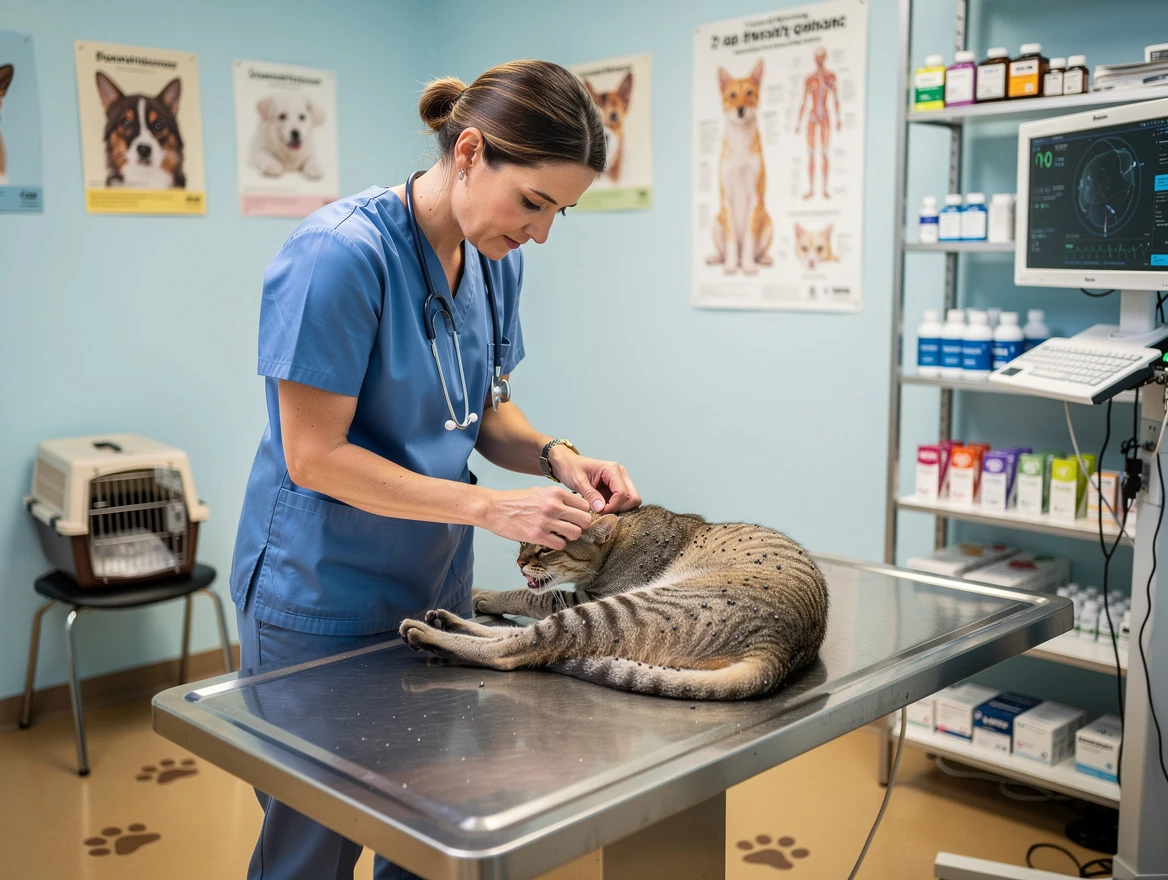
Look for excessive scratching especially at the neck and tail base, tiny black specks in the fur called flea dirt, visible small fast-moving brown insects, red bumps or scabs on the skin, bald patches from over-grooming, and behavioral restlessness. A fine-toothed flea comb run through the fur with debris tested on damp white paper is the fastest confirmation method at home.
⚠️ When to Go to the Vet Right Away
This becomes urgent when an infestation has progressed to the point of causing serious health effects. These signs mean a vet visit today rather than home treatment alone:
- Pale or white gums — indicates possible anemia from blood loss, especially dangerous in kittens
- Extreme lethargy or weakness alongside scratching
- Open sores, raw skin, or wounds from persistent scratching
- Signs of tapeworm infection — small rice-like segments near the tail or in bedding
- Kitten, senior cat, or immunocompromised cat with any flea signs — they deteriorate faster
One more situation worth a call, though not the same level of urgency as the above: if scratching persists despite consistent home treatment for more than 48 hours, that’s worth a vet visit this week rather than continuing to wait it out.
At a Glance: Key Signs of Fleas on Cats
| Sign | Description | Where to Check |
|---|---|---|
| Excessive scratching | Persistent itching and grooming beyond normal | Neck, belly, tail base |
| Flea dirt | Tiny black specks, flea feces containing digested blood | Comb fur, test on damp white paper |
| Visible fleas | Small fast-moving brown insects | Neck, tail base, belly |
| Hair loss | Bald patches or thinning from over-grooming | Areas of most scratching and biting |
| Skin irritation | Red bumps, scabs, inflamed skin | Belly, behind ears, tail base |
| Restlessness | Unusual agitation, mood changes | General behavior observation |
| Anemia signs | Pale gums, weakness, severe cases only | Gum color check |
The 7 Signs of Fleas
These seven signs are some visible, some behavioral. I’ve personally seen every one of these across my four cats at different times:

Excessive Scratching and Grooming
The most immediate signal: a sudden dramatic increase in scratching and grooming, particularly at the neck, base of the tail, and belly. Flea saliva triggers an allergic response in many cats called flea allergy dermatitis, which makes the itching far more intense than the bite alone. A cat that normally grooms moderately suddenly cannot seem to stop.
Flea Dirt in the Fur
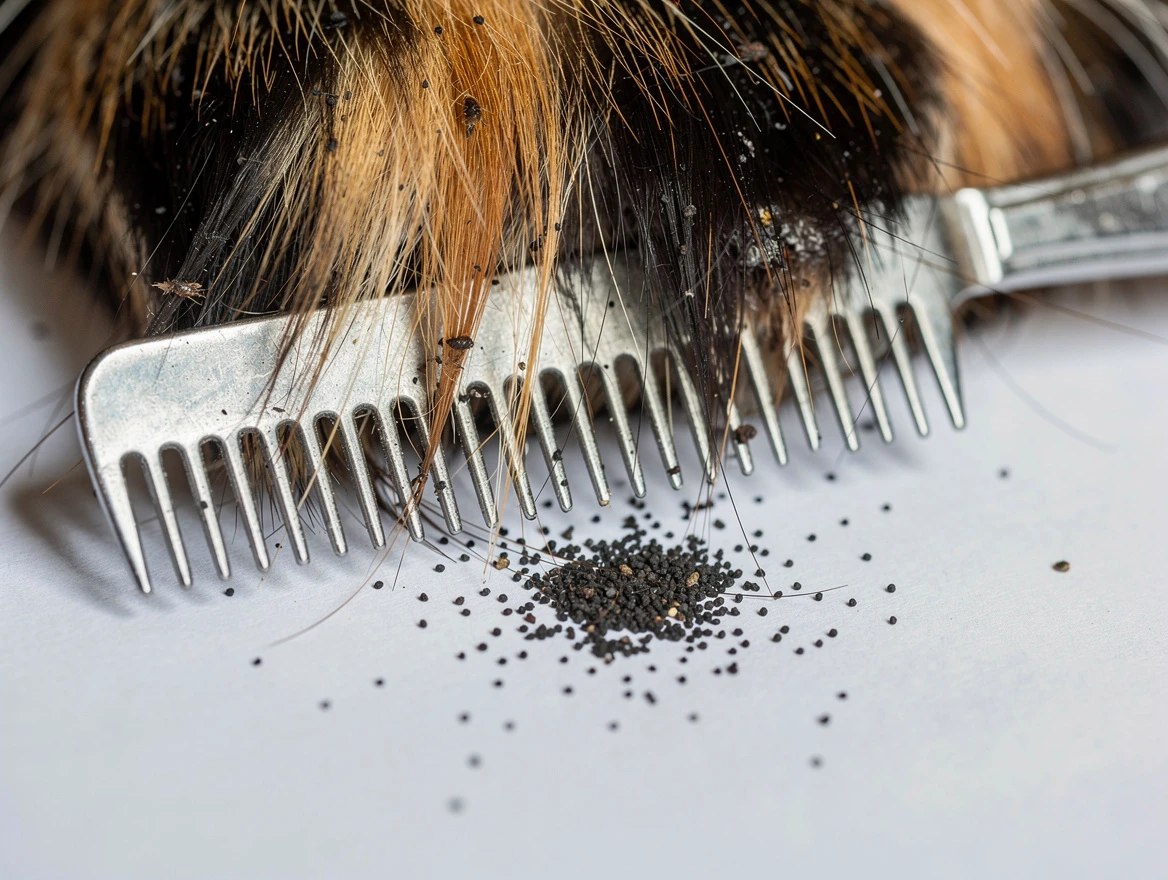
Flea dirt is flea feces composed of digested blood — tiny black specks that look like ground pepper scattered through the fur. The confirmation test: run a flea comb through your cat’s fur, tap the debris onto damp white paper, and wait 30 seconds. If the specks turn dark red or rust-colored, that’s flea dirt and it confirms fleas are present even if you can’t see the insects themselves.
Visible Fleas Moving Through the Fur
Adult fleas are small (about 1 to 2mm), reddish-brown, and move very fast. They’re easiest to spot at the neck, tail base, and belly where fur is thinner. Part the fur quickly in good lighting and watch for movement. Fleas don’t fly but jump enormous distances relative to their size, so you may see one jump when disturbed rather than sitting still.
Hair Loss and Bald Patches
Persistent scratching and biting at flea-irritated skin eventually causes hair loss — bald patches or noticeably thinned fur, particularly at the base of the tail and belly. One of my cats developed a symmetrical bald patch on both sides of her lower back during a flea episode that looked alarming before I traced it directly to flea activity.
Red Bumps, Scabs, and Skin Irritation
Flea bites leave small red raised bumps, and repeated scratching turns these into scabs and raw patches. In cats with flea allergy dermatitis, even a single flea bite can trigger widespread skin inflammation. Check the belly, behind the ears, and the base of the tail — these are the highest-traffic flea zones on a cat’s body.
Restlessness and Behavior Changes
Fleas cause constant low-level irritation that disrupts a cat’s ability to rest and relax. A normally calm cat may become visibly agitated, snappy, or unable to settle in their usual sleeping spots. I noticed two of my cats suddenly abandoning their favorite cushions during a flea episode — they had associated those spots with discomfort.
Anemia in Severe Cases
A heavy flea infestation (particularly in kittens and senior cats) can cause medically significant blood loss leading to anemia. Signs include pale or white gums, weakness, rapid breathing, and extreme lethargy. This is a veterinary emergency. Kittens can deteriorate from flea-induced anemia within days, which is why any flea sign in a young kitten warrants immediate vet contact.
What Fleas Actually Look Like
Before I’d ever actually seen one, the reality turned out to be harder to spot than I expected. Adult fleas are 1 to 2mm long, roughly the size of a sesame seed. They’re reddish-brown to dark brown, wingless, and have a flattened body designed to move easily through fur. Their back legs are disproportionately long and powerful, which is what allows them to jump up to 150 times their own height.
In practice, you’re more likely to see movement than a stationary insect. When you part the fur quickly in good light, a flea will either move rapidly toward denser fur or jump entirely off the cat. Flea dirt — the black pepper-like specks — is actually easier to find than the fleas themselves and is often the first visual confirmation you get.
Flea eggs are white, oval, and about 0.5mm — nearly impossible to see on a cat but visible on dark bedding or furniture as tiny white specks. Finding flea eggs on your cat’s bedding confirms an active infestation even if you can’t spot adult fleas on the cat itself.
How Obvious They Are by Fur Type
This depends almost entirely on your cat’s fur color and length. On a short-haired light-colored cat, a moving flea is relatively easy to spot against the pale background. On a long-haired dark cat, like my Maine Coon mix, fleas are nearly invisible to the naked eye even during an active infestation.
Flea load matters too. Early-stage infestations with only a few fleas produce almost no visible evidence beyond behavioral changes and occasional scratching. By the time you can clearly see fleas moving through the fur without using a comb, the infestation is already well-established, and the environment (your home) is also heavily infested with eggs and larvae.
This is exactly why the flea comb and white paper test matters more than trying to see fleas directly. Flea dirt is present from the very beginning of an infestation and can be detected when the flea population is still small enough to treat quickly.
How to Check Properly
This is the most practical skill for anyone trying to figure out how to tell if my cat has fleas, and it takes about five minutes once you know the method:
- Get a fine-toothed metal flea comb — plastic combs miss too much. Run it slowly through your cat’s fur in sections, starting at the neck and working toward the tail.
- Focus on the high-risk zones — the base of the tail, neck, belly, and behind the ears. These are where fleas congregate most heavily.
- After each pass, tap the comb contents onto damp white paper — or a damp white paper towel. Wait 30 seconds and watch for any specks turning red or rust-colored.
- Look for moving insects — anything that jumps or moves rapidly on the comb or paper is likely a flea.
- Check the skin directly — part the fur and look at the skin for red bumps, scabs, or irritation especially at the tail base.
- Check the environment too — run white socks across your carpet and flooring. Flea dirt and eggs will appear as black and white specks on the fabric.
On a dark-furred cat, use the damp white paper method exclusively rather than trying to spot fleas visually. The flea dirt contrast test works regardless of fur color or length.

What Kills Fleas Fastest
This is one of the most searched questions after confirming an infestation, and the honest answer is that “immediately” means within hours, not seconds:
Capstar (Nitenpyram) — Fastest Acting
Capstar is an oral tablet that begins killing adult fleas within 30 minutes and eliminates most adult fleas within four to six hours. It’s available over-the-counter and is safe for cats over 2 pounds and over 4 weeks old. The critical limitation: Capstar only kills adult fleas on the cat at that moment — it has no residual effect and does not kill eggs, larvae, or fleas in the environment. It’s a rapid knockdown tool, not a complete treatment.
Topical Spot-On Treatments — Best Overall
Frontline Plus and Advantage II begin killing fleas within hours and provide 30 days of residual protection. These are the treatments I use on all four of my cats every month without exception. They kill both adult fleas and interrupt the life cycle by killing larvae and eggs, which is essential for fully clearing an infestation from your home over four to six weeks.
Dawn Dish Soap Bath — Emergency Only
A bath with plain Dawn dish soap drowns and suffocates fleas on the cat within minutes and is safe as an emergency measure. It provides zero residual protection and should always be followed immediately by a vet-approved topical treatment. This is particularly useful for kittens too young for chemical treatments, but always confirm the kitten’s age and weight with your vet before using any flea product.
Worth knowing: fipronil resistance (the active ingredient in Frontline) is increasingly documented in some flea populations, so if an OTC product stops working as well as it used to, that’s not necessarily user error. Your vet can prescribe newer options like Revolution Plus or Bravecto, which are often more effective and, in Revolution Plus’s case, cover a broader range of parasites in one dose.
| Product | Type | Price Range | Duration | Kills Eggs/Larvae |
|---|---|---|---|---|
| Capstar | Oral pill | $20 to $40 | 24 hours, adults only | No |
| Frontline Plus | Spot-on topical | $45 to $60 for 3 doses | 30 days | Yes |
| Advantage II | Spot-on topical | $50 to $70 for 6 doses | 30 days | Yes |
| Seresto Collar | Flea collar | $60 to $80 | Up to 8 months | Yes |
Common Mistakes Cat Owners Make
These are the mistakes I see most often, and made myself early on:
- ❌ Ignoring early scratching — waiting until the infestation is obvious means waiting until your home is already heavily infested with eggs and larvae
- ❌ Using dog flea products on cats — permethrin-based dog flea treatments are toxic to cats and can be fatal; always check labels
- ❌ Treating only the cat and not the home — 95% of the flea population lives in the environment as eggs, larvae, and pupae, not on your cat
- ❌ Not treating all pets in the household simultaneously — fleas jump between animals and an untreated dog will immediately re-infest a treated cat
- ❌ Stopping treatment after the first month — flea pupae can remain dormant in carpets for up to six months and require continued monthly treatment to eliminate completely
- ❌ Using natural remedies as the only treatment — essential oils, garlic, and brewer’s yeast have no proven flea-killing efficacy and some are toxic to cats
Flea Prevention Tips
- Apply vet-recommended monthly topical prevention year-round, not just in summer
- Vacuum carpets, rugs, and upholstered furniture weekly and dispose of the bag immediately after
- Wash all pet bedding in hot water every two weeks
- Run a flea comb through your cats weekly during warm months and monthly the rest of the year
- Brief any visitors who bring pets — one unprotected dog visiting for an afternoon can seed a flea infestation
- For multi-cat households, treat all cats on the same day every month without exception
Frequently Asked Questions
Yes. Cat fleas (Ctenocephalides felis) will bite humans, typically on the ankles and lower legs, leaving small red itchy bumps in clusters. However, cat fleas cannot complete their life cycle on humans and won’t establish a long-term infestation on a person the way they do on a cat. The more significant human risk is flea bites from an infested home environment — carpets and furniture can harbor large numbers of hungry fleas that bite anyone who walks through.
A female flea begins laying eggs within 24 to 48 hours of finding a host and can lay up to 50 eggs per day. This means a single flea encounter can seed a full home infestation within two to three weeks as eggs hatch into larvae, develop into pupae, and emerge as new adults seeking hosts. This rapid lifecycle is exactly why early detection prevents manageable problems from becoming overwhelming ones.
Yes, indoor cats get fleas regularly. Fleas enter homes on human clothing and shoes, on visiting pets, through window and door screens, and sometimes directly from outdoor wildlife near the building. No indoor cat should be considered flea-immune, and monthly prevention is valuable regardless of indoor or outdoor status.
Treating the home is as important as treating the cat — 95% of the flea population lives in the environment, not on your pet. Vacuum all carpets, rugs, furniture, and baseboards thoroughly every day for two weeks. Wash all pet and human bedding in hot water. Use a household flea spray containing an insect growth regulator (IGR) on carpets and upholstery to kill eggs and larvae. Continue monthly cat treatment for at least three months after the last flea sighting to catch any dormant pupae that hatch late.
The Bottom Line
Spotting fleas early is a skill that genuinely pays off, catching a flea problem in week one is a completely different situation from discovering it in month two. The flea comb and white paper test takes five minutes and gives you a definitive answer even when no insects are visible. Excessive scratching at the neck and tail base, flea dirt that turns rust-red when wet, and behavioral restlessness are the three earliest signals to act on.
Treating the home simultaneously with treating the cat is what actually resolves an infestation. Flea products on your cat kill adult fleas, but eggs in your carpet will keep hatching for weeks. Monthly treatment consistently applied to every pet in the household, combined with regular vacuuming and hot-wash laundry, is the complete strategy.
With four cats in a city apartment, I run through this comb-check routine every single month without fail — it’s the reason we haven’t had a significant infestation in years. Five minutes monthly prevents weeks of treatment, vet bills, and a very unhappy household of cats.