
Bernese Mountain Dog Health Issues — 7 You Must Know
- Distended hard abdomen + unproductive retching — this is bloat. It kills within hours.
- Difficulty breathing or pale/blue gums
- Collapse or inability to stand
- Seizures or unconsciousness
- Profuse bleeding that will not stop
Bloat can be fatal in 2–4 hours. Do not wait. Drive to the nearest emergency animal hospital immediately.
The average Bernese Mountain Dog lives just 6–8 years. Cancer takes nearly half of them. A single diagnosis can cost $5,000–15,000. These are the realities of bernese mountain dog health issues that every owner needs to understand before — not after — they bring one home.
This is not meant to discourage you from the breed. Bernese owners will tell you there is no more loving, loyal, or gentle dog. But understanding bernese mountain dog health problems before they happen gives you real power to prevent some, prepare for others, and maximize the years you have together.
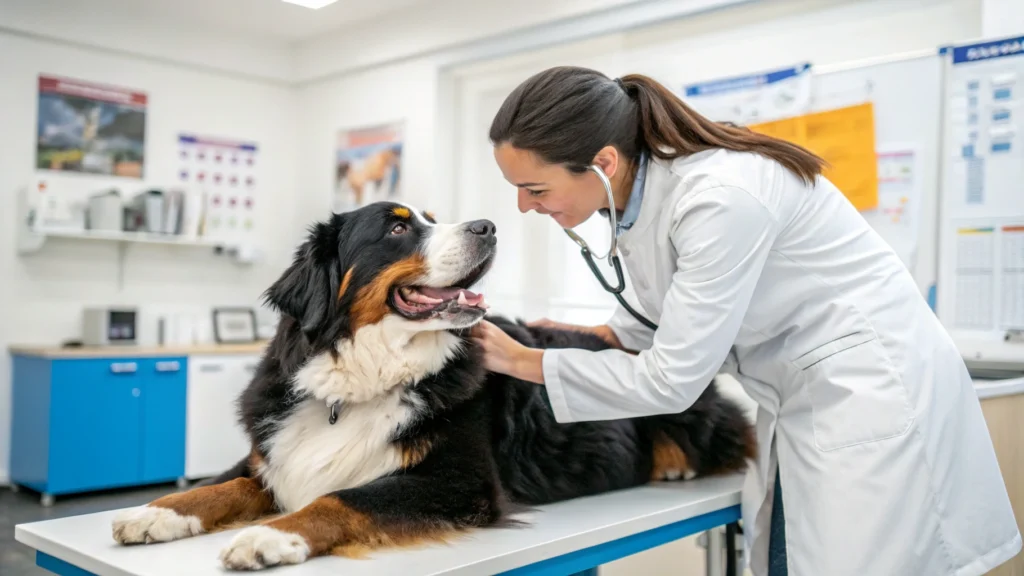
Bernese mountain dog health issues include cancer (the #1 killer, affecting 25–50%), hip and elbow dysplasia, bloat, progressive retinal atrophy, heart disease, and Von Willebrand’s disease. Average lifespan is 6–8 years. The single most important decision is choosing a breeder who health-tests both parents. Pet insurance is strongly recommended — enroll before age 3.
Bernese Mountain Dog Health Issues — At a Glance
| Condition | How Common | Avg Treatment Cost | Preventable? |
|---|---|---|---|
| Cancer (Histiocytic Sarcoma) | 25–50% | $5,000–$15,000 | No — early detection only |
| Hip Dysplasia | 15–20% | $3,000–$7,000 per hip | Partially (genetics + weight) |
| Elbow Dysplasia | 10–15% | $2,000–$5,000 | Partially (genetics + weight) |
| Bloat (GDV) | 10–15% lifetime | $2,000–$5,000 | Partially (feeding habits) |
| Progressive Retinal Atrophy | 5–10% | No treatment exists | Yes — genetic testing |
| Heart Disease (DCM) | 5–8% | $500–$1,500/year | Partially (diet) |
| Von Willebrand’s Disease | 3–5% | Management only | Yes — genetic testing |
Total potential lifetime vet costs: $15,000–$40,000+
Why Do Bernese Have So Many Health Problems
A Restricted Gene Pool
Bernese Mountain Dogs nearly went extinct in the early 1900s. The breed was rebuilt from a tiny surviving population in the Swiss Alps. That genetic bottleneck concentrated harmful mutations alongside the traits people love — the tri-color coat, the calm temperament, the gentle nature. According to the Orthopedic Foundation for Animals (OFA), this restricted gene pool directly drives the high rates of bernese mountain dog genetic diseases.
Giant Body, Accelerated Clock
Bernese males reach 80–120 pounds. Research published in The American Naturalist found that larger dogs age roughly 20% faster at the cellular level — more cell division means more opportunities for cancerous mutations. This explains why bernese mountain dog cancer rates are among the highest of any breed and why the bernese mountain dog life expectancy falls so far below expectations.
The Breeding Problem
As the breed became popular, puppy mills and backyard breeders saw dollar signs. Breeding without health testing, without tracking longevity. Every litter from untested parents rolls loaded dice — and the puppies pay the price.
The hopeful part: organizations like the Berner-Garde Foundation maintain health databases tracking which lines live longest. Some carefully bred Bernese now reach 10–12 years — proof that bernese mountain dog genetic diseases are not a death sentence when breeders take health seriously.
The 7 Major Bernese Mountain Dog Health Issues
1. Cancer (Histiocytic Sarcoma) — The #1 Killer
Bernese mountain dog cancer kills more dogs in this breed than any other cause — roughly 25–50% of all deaths. Histiocytic sarcoma attacks immune system cells, usually starting in the spleen, lymph nodes, lungs, or bone marrow. It spreads within weeks, not months. It typically appears between ages 6–8.
Warning signs: sudden lethargy, rapid weight loss, loss of appetite, difficulty breathing, new limping, swollen lymph nodes (check neck, armpits, groin), pale gums, swollen belly.
Treatment reality: Even with chemotherapy costing $5,000–10,000, average survival is 3–6 months. Palliative care with prednisone ($50–200/month) provides 1–3 months of comfort.
What you can do: Annual chest X-rays starting at age 5 ($150–250). They will not prevent cancer, but catching a treatable tumor early versus late is the difference between having options and having none.
2. Hip Dysplasia
Bernese mountain dog hip dysplasia affects 15–20% of the breed. The hip joint forms incorrectly — the ball does not sit properly in the socket — causing arthritis and increasing pain with every year.
Signs: bunny hopping, struggling to stand after lying down, avoiding stairs, swaying walk, losing muscle mass in hind legs.
Treatment: Conservative management (weight control, anti-inflammatories, joint supplements) costs $500–1,000/year. Total hip replacement costs $3,000–7,000 per hip.
Prevention: Buy from a breeder who OFA-certifies both parents’ hips with “Good” or “Excellent” ratings. Keep your Bernese lean — extra weight accelerates joint damage faster than anything else. Avoid hard-surface running before 18 months. Related: My Dog Is Limping But Shows No Sign of Pain — early limping signs in large breeds.
3. Elbow Dysplasia
Affects 10–15% and often appears alongside hip dysplasia. The elbow joint develops abnormally during rapid giant-breed growth.
Signs: front leg limping worse after rest, holding elbow away from body, stiffness after exercise.
Treatment: Conservative management for mild cases, arthroscopic surgery ($2,000–4,000) for severe cases. Most dogs need lifelong management.
4. Bloat (GDV) — The Emergency That Gives No Warning 🚨
Bernese mountain dog bloat affects 10–15% lifetime and kills fast. The stomach fills with gas, expands, then twists — cutting off blood supply. Without surgery, death follows within hours.
Memorize these signs: stomach looks bloated and feels hard, trying to vomit but nothing comes up (THE classic sign), excessive drooling, restless pacing, rapid heartbeat, pale gums, collapse.
If you see these signs — you have 1–2 hours. Go to the emergency vet.
Prevention: Feed 2–3 smaller meals instead of one large meal. Use a slow feeder bowl. No exercise for 1 hour before and 2 hours after eating. Ask your vet about prophylactic gastropexy during spay/neuter ($800–1,500) — this preventive stomach-tacking procedure is now recommended for all deep-chested breeds. Without gastropexy, recurrence rate after a bloat episode is 70–80%.
5. Progressive Retinal Atrophy (PRA)
An inherited eye disease that gradually destroys vision, eventually causing total blindness. Affects 5–10%, typically appearing between ages 3–5.
Signs: bumping into furniture in dim light, hesitating at stairs in the dark, permanently dilated pupils.
There is no treatment. But most dogs adjust remarkably well — their smell and hearing compensate. PRA is 100% preventable through genetic testing before breeding. Demand proof of PRA testing from your breeder.
6. Heart Disease (Dilated Cardiomyopathy)
DCM affects 5–8%. The heart muscle weakens and stretches, reducing pumping ability. Left untreated, it progresses to congestive heart failure.
Signs: coughing (especially at night), breathing faster than normal, getting tired on easy walks, fainting, loss of appetite.
Treatment: Lifelong medications — Pimobendan, ACE inhibitors, diuretics — running $100–300/month.
Important: The FDA issued a warning investigating grain-free diets and DCM. Many veterinary cardiologists now recommend grain-inclusive diets from established brands and taurine supplementation (500–1,000mg daily).
7. Von Willebrand’s Disease (vWD)
A bleeding disorder affecting 3–5%. Blood does not clot properly, making even minor injuries potentially dangerous.
Signs: cuts that will not stop bleeding, nosebleeds, bleeding gums, blood in urine or stool, excessive bleeding during surgery.
Critical: Tell your vet about this diagnosis before ANY surgical procedure. Avoid aspirin and NSAIDs. Like PRA, vWD is completely preventable through genetic testing before breeding.
Bernese Mountain Dog Lifespan — The Hard Truth
Average bernese mountain dog lifespan: 6–8 years. For comparison — Golden Retrievers average 10–12, Labradors 10–12, even Great Danes 7–10.
Can you extend it? You cannot rewrite their DNA. But you can genuinely shift the odds:
- Weight management — the single biggest factor you control. Lean dogs live up to 2 years longer. Your Bernese should be lean enough to easily feel ribs.
- Cancer screening at age 5 — annual chest X-rays catch treatable tumors before they become untreatable
- Quality nutrition — large-breed formulas from established brands. Given DCM concerns, many vets recommend grain-inclusive options
- Joint supplements from early on — starting glucosamine at 6–12 months protects joints before damage begins
- Breeder choice — some bloodlines consistently produce dogs living 9–12 years. Ask: “What is the average lifespan in your lines?” If they dodge the question, walk away
Prevention — Choosing a Healthy Puppy
Are bernese mountain dogs healthy? Not naturally, no. But choosing the right breeder dramatically changes your individual dog’s odds.
| Required Test | What It Screens | What You Want |
|---|---|---|
| OFA Hip Certification | Hip dysplasia | “Good” or “Excellent” |
| OFA Elbow Certification | Elbow dysplasia | “Normal” |
| Eye Exam (CAER) | PRA and eye diseases | Clear annual certification |
| Cardiac Exam | Heart disease | Normal echocardiogram |
| vWD DNA Test | Bleeding disorder | Both parents “Clear” or max one “Carrier” |
| PRA DNA Test | Progressive blindness | Both parents “Clear” or max one “Carrier” |
Walk away immediately if: breeder says “my dogs are healthy, I don’t need to test” — cannot produce OFA certificates — has multiple litters with no waiting list — price is below $2,000 (quality Bernese cost $2,500–4,000).
Recommended Supplements
- Joint support (start at 6–12 months): Glucosamine + Chondroitin 1,500–2,000mg daily + MSM 500–1,000mg daily
- Heart health: Taurine 500–1,000mg daily + Omega-3 fatty acids 2,000–4,000mg EPA/DHA daily
- Estimated monthly supplement cost: $70–150 — compare that to a $7,000 hip replacement
Why Pet Insurance Is Not Optional for Bernese Owners
- 50% of Bernese face at least one health crisis costing $5,000+
- Cancer treatment: $5,000–15,000
- Hip replacement (both hips): $6,000–14,000
- Emergency bloat surgery: $2,000–5,000
Without insurance, owners face a choice nobody should have to make: serious debt or euthanizing a dog that could have been saved.
| Provider | Key Benefit | Est. Monthly Cost |
|---|---|---|
| Trupanion | Unlimited lifetime coverage, 90% reimbursement | $120–150 |
| Healthy Paws | Unlimited annual coverage, fast claims | $110–140 |
| Embrace | Diminishing deductible rewards healthy years | $100–130 |
The math: Total premiums over 7 years: $8,400–12,600. One cancer diagnosis: $8,000–15,000. One hip replacement: $6,000–14,000. Pet insurance pays for itself with a single major claim.
Vet Visit Schedule by Age
Ages 1–4: Building the Baseline
| What | How Often | Cost |
|---|---|---|
| Comprehensive exam | Yearly | $50–100 |
| Blood work | Yearly | $100–200 |
| OFA hip/elbow X-rays | Once at age 2 | $200–400 |
| Eye exam (CAER) | Once at age 2 | $50–100 |
Ages 5–7: Cancer Watch Begins
| What | How Often | Cost |
|---|---|---|
| Comprehensive exam | Every 6 months | $100–200 |
| Blood work | Yearly | $100–200 |
| Chest X-rays (cancer screening) | Yearly | $150–250 |
| Cardiac screening | Once | $300–500 |
Ages 8+: Senior Monitoring
| What | How Often | Cost |
|---|---|---|
| Comprehensive exam | Every 6 months | $100–200 |
| Blood work | Every 6 months | $200–400 |
| Chest X-rays | Every 6 months | $300–500 |
Frequently Asked Questions
Cancer — specifically histiocytic sarcoma. It affects 25–50% of the breed and is the leading cause of death. It typically appears between ages 6–8 and progresses aggressively, with average survival of 3–6 months even with treatment. Annual chest X-rays after age 5 are the only proactive screening tool available.
Average bernese mountain dog lifespan is 6–8 years, with a median around 7. That is roughly half the lifespan of other breeds their size. Some Bernese from health-tested bloodlines reach 10–12 years. Weight management, cancer screening, and breeder choice all improve the odds.
Compared to most breeds, no. They face higher cancer rates, more orthopedic issues, and shorter lifespans. However, a Bernese from health-tested parents with a committed owner who follows prevention strategies can live a happy, comfortable life. The breed requires more awareness, screening, and financial preparation than most.
Baseline costs: $1,500–3,000/year for routine care and supplements. Over 7 years that is $15,000–25,000. Major health events add $5,000–15,000 each. Total lifetime spending can exceed $40,000. Pet insurance at $100–150/month is the most reliable way to manage these costs.
Without hesitation, yes. Half of all Bernese face a health crisis exceeding $5,000. Enroll before age 3, choose a plan covering hereditary conditions and cancer with high or unlimited limits. One major claim will likely exceed every premium you have paid over your dog’s entire life.
Some can. PRA and Von Willebrand’s disease are 100% preventable through genetic testing. Hip dysplasia risk drops with OFA-certified parents and weight management. Bloat risk decreases with proper feeding and prophylactic gastropexy. But histiocytic sarcoma has no genetic test and no proven prevention — early detection is the best tool available.
The Bottom Line
Bernese mountain dog health issues are serious and real. But understanding them gives you power. Choose a breeder who health-tests both parents, enroll in pet insurance before age 3, keep your Bernese lean, start joint supplements early, and begin cancer screening at age 5. You cannot guarantee a long life with any dog — but you can guarantee that every year they get is as healthy and comfortable as possible. Related: How to Stop Dog Shedding — Bernese shed heavily year-round and need consistent coat management. Also see: Why Does My Dog Bark in His Sleep — understanding your dog’s sleep behavior and when it signals a health concern.

This article is for educational purposes only and does not replace professional veterinary advice. If your Bernese shows signs of bloat or any emergency, seek immediate veterinary care.